


Menu
By theme
By theme


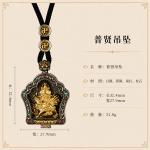
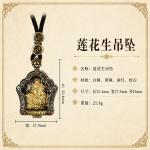
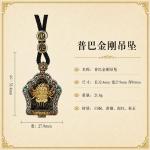
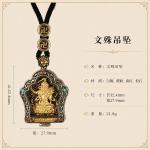
{{ variable.name }} : {{ variable.values[selectedVariantsIndex[variable_index]].name }}
Quantity:
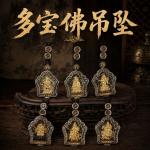
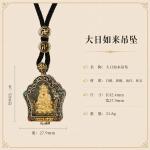
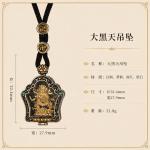
Six designs in one listing, and choosing between them is harder than choosing the material. Padmasambhava, Samantabhadra, Vajrakilaya, Manjushri, Mahakala and Vairocana belong to different systems: Padmasambhava is a patriarch of the Nyingma school, Vajrakilaya a wrathful deity, Mahakala a protector, Vairocana the dharmakaya Buddha, while Manjushri and Samantabhadra are bodhisattvas. Without sorting out how they relate, it is easy to end up with two of the same kind. Of the six names, Mahakala and Vajrakilaya are the pair most often confused. All six are about the same size, so the difference lies entirely in how dense the detail is.
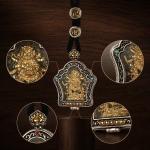
By appearance they fall into two lines, peaceful and wrathful. Manjushri, Samantabhadra and Vairocana are peaceful, with rounded lines, and suit everyday wear. Vajrakilaya and Mahakala are wrathful, with flames, skulls and many arms, and their detail is dense enough to blur at small size. If you are drawn to the wrathful forms, accept that they must simplify at this scale. The smaller the piece, the more the wrathful figures suffer for it, and nothing can be done about that. Peaceful figures are judged by the face, wrathful ones by the hands; the emphasis is different.
White copper's role here is to hold the detail. The arms, implements and flame patterns of the wrathful figures depend on sharpness at the edges, and a material that is too soft rounds off after a few moulds. White copper is hard enough to keep fine lines, at the cost of darkening quickly once the recesses are blackened, and in the deep channels of flame patterns it goes black and bright. The other advantage is that it resists deformation, so slender implements do not bend.
If the pendant is a gift, do not choose the deity for the recipient. This is a personal matter, and the one you find beautiful may mean nothing to them. The safe course is to let them choose, or to pick something widely accepted such as Manjushri or Samantabhadra. If they have named a deity, buy that one and you cannot go wrong. If the packaging carries the name of the deity, keep it, because it is useful if the piece is ever passed on.
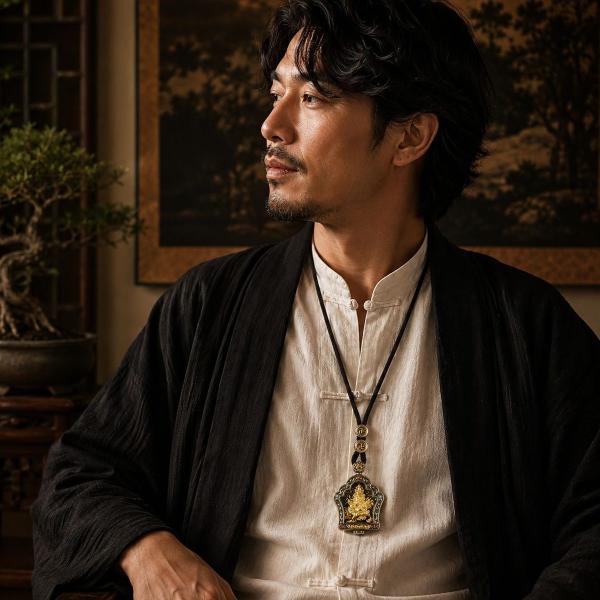
The back is usually plain, so it does not dig in against the skin. Choose a fine chain: the pendant carries its own weight, and a thick chain makes it look top-heavy. Wipe a darkened surface with a dry soft cloth rather than silver dip, since those liquids are unkind to a copper-nickel alloy and tend to leave patchy marks. Take it off to shower, because moisture trapped behind it will spot as well. Choose a spring clasp, since an S-hook with a small pendant opens by itself.