


Menu
By theme
By theme





{{ variable.name }} : {{ variable.values[selectedVariantsIndex[variable_index]].name }}
Quantity:
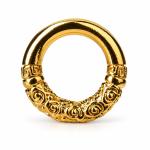
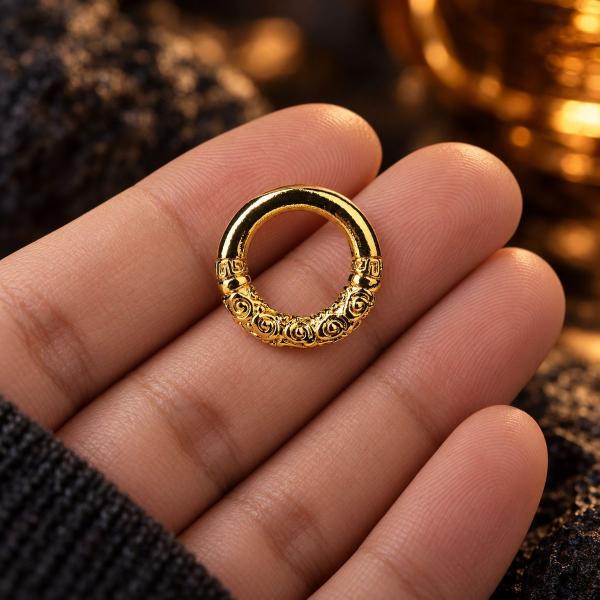
The meander runs ring upon ring and closes into an open circle. The ring is not closed; a gap is left between the ends so other pieces can be threaded on. Cloud scrolls run on the outer band and meander on the inner, one soft and one hard, crowded onto a narrow ring. The body is thin — a line seen from the side — and takes no room on a cord. The curves of the cloud run with the grain while the right angles of the meander cut across them, so a little space has to be left at the edges or it crowds. The width is even, with no taper from one end to the other.
A sliding ring is the piece on a strand that moves, threaded on the outside of the main cord rather than fixed. Wherever it slides, there is one more bit of sound. Some use it as a spacer; some just like the noise it makes coming down. It cannot be too small or it will not slide, nor too large or it rattles and keeps knocking the beads. Its inner diameter is a little larger than the cord, which is what lets it run; too close and it jams where the cord knots. Some thread two at once, and the sounds overlap, which is also pleasant.
The meander grew out of the thunder pattern, one stroke running on without breaking, which is why folk call it wealth that never breaks off. The danger in cutting it is a break, and a break at a corner unravels the whole line. Look closely at the corners on this one: whether the square turns were skimped shows at a glance, and a corner cut shallow rounds off after a while. The cloud lines are soft and sit against the hard folds of the meander, and soft against hard is what makes it worth looking at. There are many meander strokes, and they meet evenly all the way round, with the joins hidden in the bends of the cloud. The cutting is shallow; a finger finds a low ridge, nothing that catches.
An open ring has to be bent to go on. White copper is tough and will take a bend or two, but bend it often and fine cracks start at the opening. Take it on from the side of the main cord; do not drag beads through. The wall is thin, so keep pliers off it — a grip leaves a mark, and the mark will not polish out. The cut ends of the opening are dressed and do not scratch. The gap is not wide, so on a fine cord it slips off easily; when fitting it, push with the gap against the side of the cord.
The pattern is shallow and dust gets in quickly. Dust in the square corners of the meander should be lifted with the blunt end of a toothpick, not a needle point. When white copper darkens the pattern reads more clearly, so there is no need to polish it bright. Do not wear it in the bath: water sits between ring and cord and leaves a green ring at the contact. A lost sliding ring is hard to match, so pinch the opening a little tighter when you fit it. Thin white copper does not like pressure; pressed against hard things in a bag it bends, and a bend will not straighten. Wrap it in paper when it comes off; thin pieces chip each other.