


Menu
By theme
By theme




{{ variable.name }} : {{ variable.values[selectedVariantsIndex[variable_index]].name }}
Quantity:
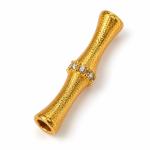
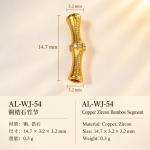
The bamboo node worked onto a bead takes its meaning from growing one joint higher. Bamboo has stood in Chinese courtyards for thousands of years, and Su Dongpo wrote that he would sooner go without meat than live without bamboo, which is a statement about clarity rather than appetite. Real bamboo is jointed and hollow between the joints; shrunk to a bead, that becomes a raised ring with a groove left on either side. The joint should swell and the groove should draw in, and only that alternation gives the plant its spring. Bamboo matures in a year and resprouts after cutting, and mountain families lived off it — that layer of meaning is more solid than any talk of refinement.
Hammering is the other route. A hammer face struck again and again leaves dents that are never round, and light falling on them breaks into many small pieces instead of the single sheet of a polished surface. Set the node against the hammer marks and one carries the form while the other carries the surface, and they do not quarrel. The spacing of the marks needs judgement: too dense and it looks like fish scales, too sparse and it looks like damage. Machine-stamped texture is even, and after a while it is dull, with none of that temper in it.
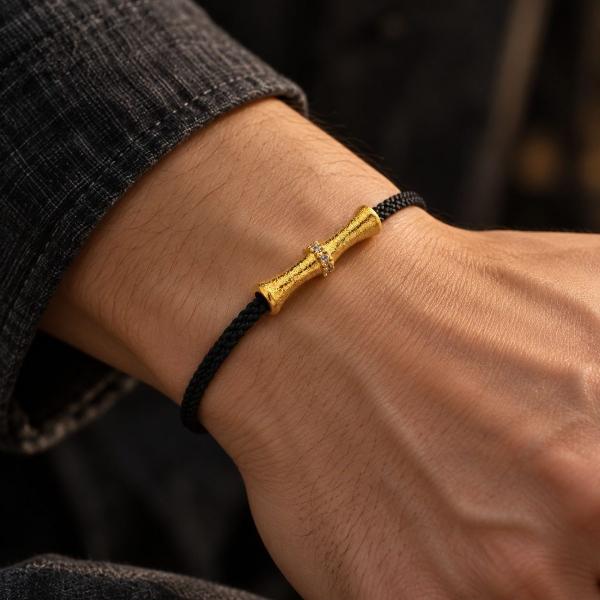
A through-hole bead is flexible in the strand. It can sit as the top bead, or be worked in between as a spacer; the hole runs straight, so even heavy cord passes without crowding. The raised node stands a size wider than the body, so thread it along the hole rather than forcing it, which frays the cord. Used as a top bead, leave enough room at the three-hole bead, or the knot jams against the node. And the position has to be tried: once the strand is together the balance shifts, and a single bead on a table tells you nothing.
The finish decides what it will sit with. Dark is the most adaptable — wood, bodhi seed, turquoise all go in; bright suits a strand on its own, and once there are several fittings it turns busy. Dust lodges in the hammered hollows, so brush it dry with a soft brush rather than soaking it, because water in those seams takes a long time to come out. On a hand that sweats, a metal spacer will darken over one summer, and that is normal. Metal beside wood on the same strand will polish a shine into the wood. That is the trade you are making.
As a gift, the bamboo reading is worth voicing: hollow within, jointed without. The phrases are old, but on a bamboo node they are not a stretch, and they stand up better than talk of rising step by step. Younger customers buy these one or two at a time, building a strand; a spacer is a thing you accumulate, not a set you buy at once. In the end the bamboo node is usually the first piece anyone recognises. Priced by the bead, it is easier to say yes to than a whole strand, which is a large number to hold in the hand.