


Menu
By theme
By theme






{{ variable.name }} : {{ variable.values[selectedVariantsIndex[variable_index]].name }}
Quantity:
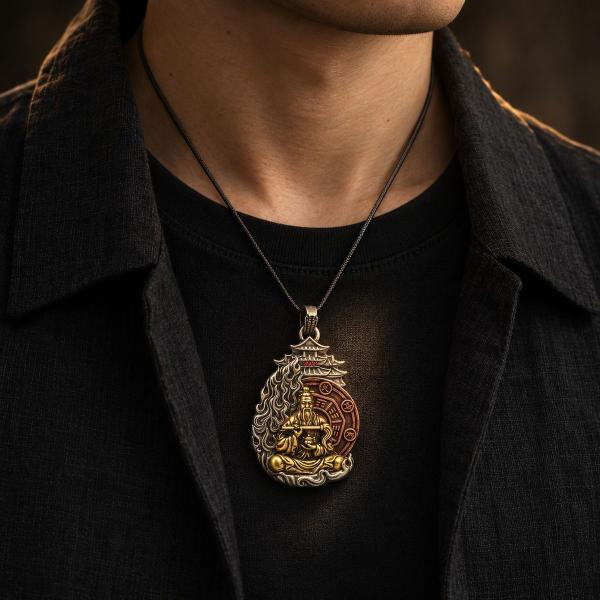
Taiqing is one of the Three Pure Ones of Daoism, the realm where the Supreme Lord Lao dwells, and the name is used of the deity as well. The plaque takes those two characters and pairs them with a relief of old architecture — roof ridges, bracket sets, railings, columns — drawing on the sense of a realm rather than a building. Of the Three Pure Ones, Yuqing, Shangqing and Taiqing each hold a place, and Taiqing answers to the Heaven Worthy of the Way and its Virtue, the best known of them among ordinary people, because the stories of Lord Lao are many. The two characters usually run vertically on a plaque; set horizontally they go flat. The halls shown are mostly three bays wide. More and it crowds.
The difficulty in architectural relief is perspective. A hall has depth and the relief is one skin thick, so it has to fool the eye by stacking near over far: the front eave high, the rear ridge low, a shadow left between them, and a courtyard appears. The rows of roof tiles have to be laid one by one; get the order wrong and the roof caves in. Rein in the lift at the eave corners — too much and it looks like a stage set, and the steadiness that makes the building is gone. The bracket sets need their layers pressed out; left flat they become a decorative border with no structure in them.
Setting a building on a square plaque needs sky left above it. A roof jammed against the top edge looks choked; leave a sliver of open ground and the thing has room to rise. The lower edge should take a horizontal line, which is what pins the ground. Do not cut the brackets too full, because dense they become a row of teeth and at a distance only sawteeth remain. Make the back flat so it does not dig into the chest; a curved back lies closer, but wastes material and is harder to make. And do not wash an antiqued piece, or half the black comes off.
Antiqued and untreated are two different sales. Antiqued, the hollows go black and the layers of tile and bracket read at a glance; untreated, the piece is bright all over, clean, but flat from a distance. Never clean an antiqued piece with toothpaste, since what you abrade is exactly that black. To deepen the layers, rub a soft cloth over the high points and leave the hollows alone. The black sits mostly in the tile seams and the brackets, so keep the cloth off them. Pair the plaque with a dark cord; a bright chain competes with it.
Necklace and plaque differ by a chain. The plaque has thickness, so choose a chain that can carry it; too fine a one will cut into the neck. It suits an elder, or a friend who builds or paints — talk about the two characters, which is safer ground than feng shui. Antiqued goes with a dark cord, bright with a metal chain; each to its own route. These plaques look well on dark clothing and heavy on light. Give one to a designer and they will see the work in the perspective.