


Menu
By theme
By theme



{{ variable.name }} : {{ variable.values[selectedVariantsIndex[variable_index]].name }}
Quantity:
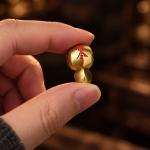
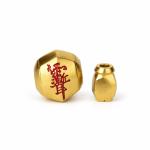
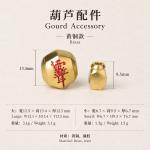
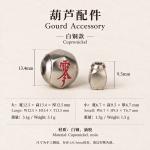
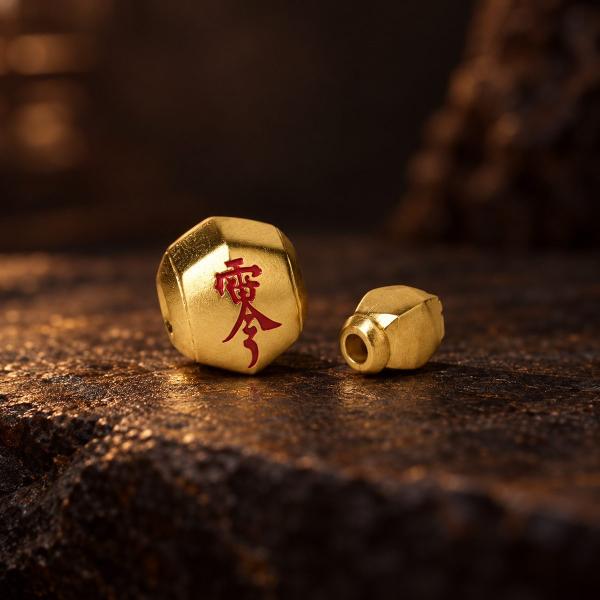
The virtue of a hexagon is that it will not roll. Six flat faces and squared ends sit still on a cord, which makes it far easier to live with than a round bead. Set a gourd motif on a blocky body like this and the curves are pressed into facets: from across the room it reads as a bead, and only up close do you find the waist. That double reading wears better than a small carved gourd, and it does not snag on clothing.
Two colours, white and yellow. The white is the natural tone of the alloy, on the cool side; the yellow leans toward old bronze and warmth. Mixed in one strand, the difference lets you read the sequence of the beads, which is more interesting than a uniform run. On fair skin the white looks clean and the yellow flatters dark clothes. The two do not fight side by side: use white for the spacers and yellow for the main bead, and the strand gains a hierarchy. Polished too bright, the white version loses the waist of the gourd; the yellow, darkened by oxidation, keeps that line legible.
As a component, the hole comes first. A barrel bead takes a straight through-hole, and the mouths should be chamfered so the cord can rub back and forth without fraying. The six edges need polishing too; a sharp arris will chew through thread. When the piece arrives, run a length of cotton through it and pull a few times, feeling for any catch. A catch is usually a casting burr left at the mouth. A properly chamfered mouth feels like a smooth ring under the finger; an unchamfered one announces itself as an edge.
It belongs in the middle of a bracelet as a spacer, or beside the main bead as support. Under the guru bead it also works, though the hexagon is bulky and a thin cord will not carry it. The waist of the gourd happens to catch a knot, so the finishing knot can be hidden behind it and disappear. Wooden beads are the safest pairing; southern red agate and turquoise are equally forgiving. Keep it away from brightly polished metal, which flattens it.
In folk reading the gourd sounds like fulu, fortune and emolument, and the trailing vine adds the old wish for generations of descendants. None of that needs to be believed; it serves well enough as a pretext. For a friend who makes things by hand, this is a better gift than a finished piece — a component is by definition an invitation to improvise. Buy two at once, one white and one yellow, and the matching later is easy. Once the strand is put together, nobody asks what the beads cost.