


Menu
By theme
By theme

{{ variable.name }} : {{ variable.values[selectedVariantsIndex[variable_index]].name }}
Quantity:
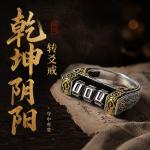
One long line, two short ones, six of them stacked: that is a hexagram. Qian and Kun are the first two of the sixty-four, all yang and all yin, and between them they hold heaven and earth, hard and soft, movement and stillness. The “turning yao” in the name refers to yao change: a primary hexagram produces a changed one, and whichever line moves is the line the reading rests on. The Book of Changes says that movement brings change, which is a more durable thought than a phrase about good fortune.
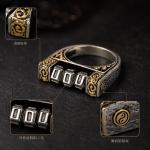
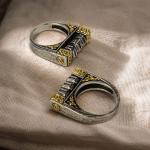
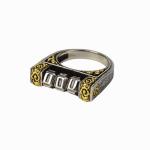
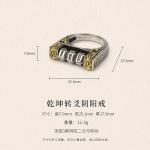
Cutting hexagram lines into a ring face is mostly a problem of spacing. A yang line is one bar; a yin line is broken in the middle, and the break has to be clean and the two halves equal, because half a hair of error reads as crooked. White copper casts geometric patterns more easily than figures — straight lines do not fight the tool and the edges come out clean. But geometric work also forgives nothing. One line goes off and the whole ring goes with it. The sliding blocks in the mould have to be exact; once a block works loose, every line comes up with a burr.
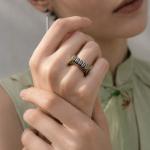
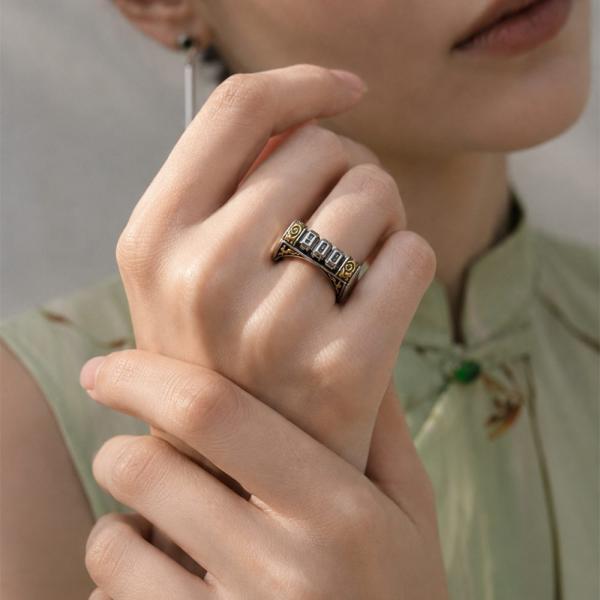
The open band leaves room in the sizing. A finger changes through the day, thin in the morning, swollen by evening, and a closed ring that fitted at ten will pinch by four. An open ring can go half a size looser, at the cost of the face drifting off centre, so push it straight when you put it on. Take it off for heavy work: one knock against iron and a corner of the hexagram is gone. And bend it with both hands braced against each other, never with one hand forcing the band, or you will make an oval.
Qian and Kun, the bagua, this whole family of patterns: the point is that it can be read, not that it does anything. Someone who knows the Changes will count the line positions; someone who does not sees stripes; neither reading is wrong. It suits a friend who reads old books, plays go, or fusses over tea, better than one who is only interested in luck. If the recipient can point at the ring and say whether it is Qian or Kun, the gift has landed. And out in the world, somebody always asks which hexagram it is, which starts a conversation.
There is not much to the upkeep. White copper dislikes sulphur, so do not wear it into a hot spring and do not leave it in a drawer with rubber bands. When the surface dulls, wipe with a silver cloth in one direction rather than in circles — circles scramble the polish lines and the light goes muddy. The seam inside the band is where sweat collects, so take it off before a shower. Stored in a zip bag, it will change colour more slowly. White copper ages evenly; there is no plating to flake into patches.