


Menu
By theme
By theme





{{ variable.name }} : {{ variable.values[selectedVariantsIndex[variable_index]].name }}
Quantity:
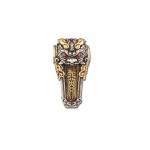
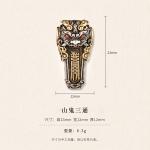
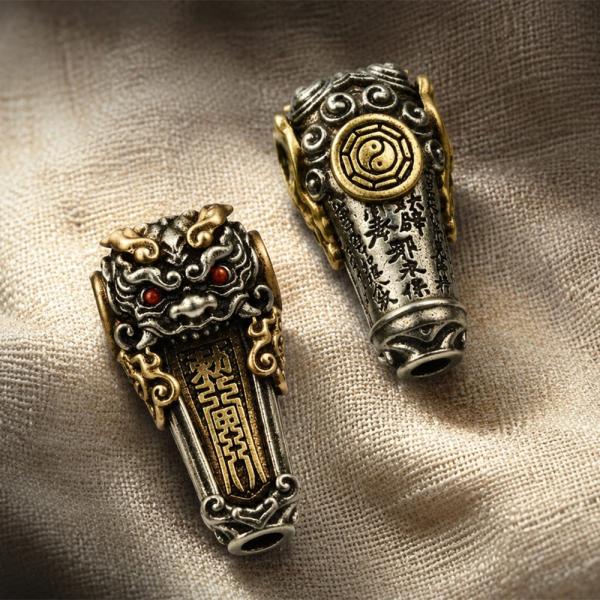
The position at the head of a strand is called a santong in the trade, a three-hole bead. Three holes meet inside it: two run straight through for the main cord, and the third drops from the bottom to take the Buddha head or a pendant, with the knot tucked back into the hole. A strand with one of these has a beginning; without it, it is only a loop. The bead above is the Buddha head, and the two are usually sold as a set, because bought separately they are easy to mismatch.
The name shangui, mountain ghost, comes off the old charm coins. One class of those coins carries a thunder command on one face and a mountain ghost on the other, with a Daoist incantation between them: a warding currency that never circulated and was only ever hung. A three-hole bead borrows that motif, which is effectively the face of a charm coin reduced to the size of a strand. How deep the cuts sit tells you at a glance whether it was taken from an old coin or cut freehand. The mountain ghost characters are usually raised out of a recessed ground, and raised strokes are the first thing to wear flat.
White copper is lighter than silver of the same volume, so it does not drag at the wrist. The inside of the holes must be smooth, because the cord rubs back and forth there all day and a rough wall is what kills thread. Shine a torch through when the piece arrives; if you see burrs, roll a strip of fine paper into a tube and turn it a few times. Where the three holes meet is the likeliest place for casting flash, and if that junction is blocked the cord jams solid. And if the three holes are not in one plane, the strand will twist and the pendant will hang crooked.
When stringing, the three-hole bead should be one size larger than the main beads, or it will not read as the head. On colour, white copper is cool and holds its own against southern red or turquoise; against white bodhi or ivory nut it blends away and needs a spacer to separate it. A Buddha head tower completes the transition if you have one. White copper sits well with dark wood, the warm and the cold balancing; with copper beads of the same tone it muddles into one mass.
This is a component for someone who has been stringing for a while. A beginner will not know how to finish the cord, and the three holes are easy to misread — the downward hole taken for a passing hole, so the pendant has nothing to hang from. If you are unsure, hand it to the stringer at the stall; a few yuan saves you unpicking the whole strand. Elastic or plain cord is a matter of habit, elastic easier, plain better looking. Leave two fingers of slack when you finish, because a cord cut short can never be lengthened.