


Menu
By theme
By theme


{{ variable.name }} : {{ variable.values[selectedVariantsIndex[variable_index]].name }}
Quantity:
The Tang lion and the Ming-Qing stone lion are not the same animal. Ming-Qing lions are codified — the ball, the cub, the curled mane, the bell, one convention after another. Tang lions mostly crouch with the chest lifted, limbs thick, head small and body heavy, and the presence comes out of the mass rather than the detail. The tail usually lies against the body instead of curling up the way Ming-Qing lions do, and that single point is the best guide to the period. If you are used to the lions outside a gate, a Tang lion looks blunt. Blunt is not stupid; it is a refusal to flatter.
An animal cut in natural stone is one of a kind. The block has veining, cotton, bands of colour, and the usual practice is to keep the clean face for the face and push the mottling round to the back. Two pieces of the same model therefore differ in depth and translucency, which is not a fault but the temper of the material. Do not choose from a photograph; under studio light every stone looks well. The direction of the veining matters too — bands running across the face press it down, bands running along the body read more easily.
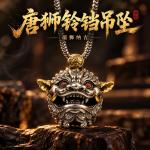
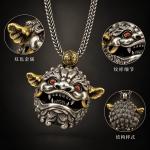
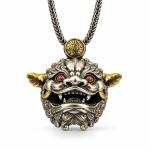
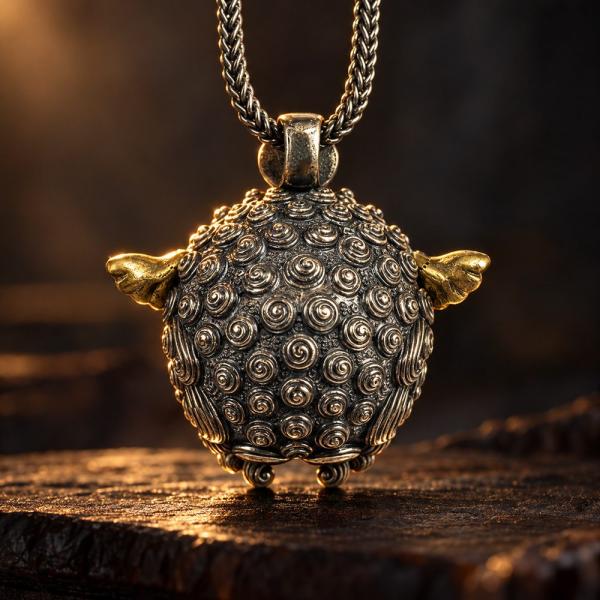
Three versions: the pendant alone, a large bell, a small bell. The bell versions hang a bell beneath the beast, which sounds as you walk. Whether the note is crisp depends on the wall of the bell: thin walls ring sharp, thick ones sound dull. Stone with a bell is less bright than all brass, but it is also less noisy, which suits a bag. The large bell goes behind a door, the small one on a bag, and the plain pendant on a cord. The clapper is fitted separately and can be replaced; if you cannot match it, change the bell rather than forcing a fit.
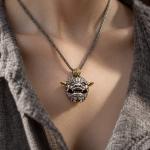
The charm does not stand on ceremony. Bag, keys, a car’s sun visor rather than its mirror, a cabinet handle — all fine. Use waxed cord or jade thread and finish with a snake knot, which is simpler than a metal clasp and will not scratch. In a car do not use a long cord: brake hard and the thing flies into the glass, which has happened more than once. Leave a finger’s width of slack in the knot, because a knot pulled tight will eventually cut the cord.
The Tang lion came in along the Silk Road as an auspicious beast, with a lion behind it, though some of the scholarship says tianlu or bixie, and the line of transmission is disputed. For a gift, “an auspicious beast that keeps watch” is enough. Do not push it toward Tang antiquities, which are a different subject altogether. At this price nobody is taking it seriously, and saying too much spoils the exchange. The stone darkens year by year. That is oxidation, not dirt.