


Menu
By theme
By theme




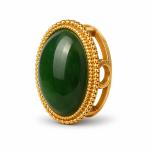
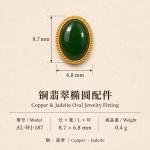

{{ variable.name }} : {{ variable.values[selectedVariantsIndex[variable_index]].name }}
Quantity:
The piece that hangs down the back of a court necklace is called a beiyun, a “back cloud.” A full court necklace runs: the Buddha head at the nape, the Buddha head tower below it, then the back cloud, and then a drop at its end. It falls where the wearer cannot see it, and yet it is the gathering point of the whole string, joining the beads in front to the drop behind. Half the weight of a court necklace rests on this invisible component. The rules for such necklaces are fussy — the material of the Buddha head, the placing of the counters — and the back cloud is one link in that system, the easiest to find and the easiest to get wrong.
The oval is a softer shape than a square plaque. Pierced, it loses half its weight and does not press into a collar. The openwork is usually scrolling vine or cloud, and the openings should be even in size: the large ones crack, the small ones fail to fill. When judging pierced work, look first at the bars left between the holes. One broken bar and the piece is scrap. A solid rim should always be left around the edge; fully pierced pieces chip at the border within a season.
White copper is cool in tone, invisible against dark clothing and visible only over something pale. Some customers feel it is not precious enough, but this is a component that lives at the back; the material matters less than the shape being right. If you want to spend, spend on the Buddha head, which is what faces the room. Polished too brightly, white copper looks thin against silk; a matte finish sits better with dark cloth.
Nobody strings to the old court rules now, and the back cloud is usually taken out and used on its own: as the main pendant of a bracelet, as a bag charm, as the middle section of a necklace. The oval is easier to place than a square — hung horizontally it is a plaque, vertically it is a pendant. Set into the middle of a necklace with fine chain on either side, its weight falls just below the collarbone. Old pieces broken up for reuse often have remnants of the original cord packed into the holes, which must be cleaned out first.
When reworking, watch the holes. A back cloud normally has one at the top and one at the bottom: the top takes the cord, the bottom takes the drop. A single-hole old piece needs a ring to make the transition. Do not force a thick cord through a fine hole, because the mouth will split, and white copper is not easy to repair once split. If you add a drop, its weight should not exceed the back cloud’s, or the whole thing hangs forward. Use split rings rather than prising a closed ring open, which leaves a hidden crack that will fail later.