


Menu
By theme
By theme





{{ variable.name }} : {{ variable.values[selectedVariantsIndex[variable_index]].name }}
Quantity:
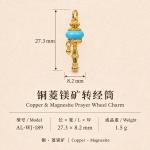
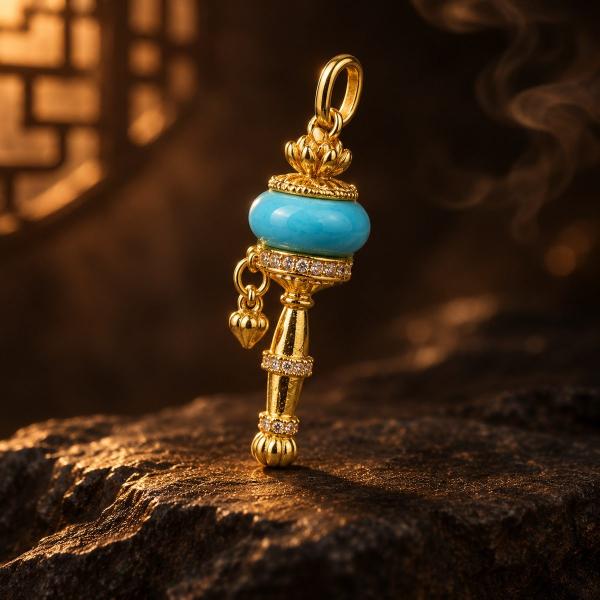
The proper name for a Tibetan prayer wheel is a mani wheel: scriptures inside, the six-syllable mantra on the outside, turned by hand. It turns clockwise, and that rule is strict — turn one the wrong way in Tibet and someone will stop you. The small component borrows the form, keeping body, lid, and axle, scaled down to hang on a strand. Get the form right and the meaning arrives with it; nothing more is required. Here it is mostly an ornament, and there is no reason to be coy about that. The lid is usually pressed into place: too tight and it will not turn, too loose and it falls off.
The mantra, om mani padme hum, is Avalokiteshvara’s root invocation. Cut around the wall of the cylinder, it runs a full circuit, and whether the characters stand with their heads up or facing outward varies by workshop. Cast characters are slightly thick, which is an advantage at this size, since they stay legible. If they blur into a single mass, then you have a spinning tube and no motif at all. The number of syllables is fixed, so the spacing has to be calculated precisely to close the circle.
As a component it is bulkier than an ordinary spacer, and the position has to be chosen with that in mind. At the centre of a bracelet as the focal piece, or on a bag as a charm; pinched between two small beads it looks out of place. It has an axle, so the cord must not be too thick or the cylinder will not turn. Replace a worn cord early, because once the axle sits crooked it binds. On a bag it will rub against the fabric, and the characters will brighten where it does.
The metal is on the dark side, and the antiqued finish is more common than the bright one: dark in the hollows, bright on the raised work, which reads as age from a distance. Worn properly for years, the places the hand touches come up bright, and that brightness is not the same as the antiqued finish — it cannot be wiped away. The trade calls it patina. It cannot be hurried; an old piece has decades of it, and no workshop can imitate the real thing.
The subject is religious, so keep the sales talk restrained. There is no need to say it contains scriptures, because at this size it usually only borrows the shape; and no need to say that turning it earns merit, which is a matter for believers in Tibet and sounds dismissive when said to a Han customer. Say plainly that it is a Tibetan-style component and nobody will misunderstand. A customer who knows will nod; one who does not needs no sermon, and too much talk sounds like a pitch. If someone asks whether scriptures can go inside, say that this size will not take them. Better than being vague.