


Menu
By theme
By theme

{{ variable.name }} : {{ variable.values[selectedVariantsIndex[variable_index]].name }}
Quantity:
The name Wenchang has two origins in the old books. One is the six stars of Wenchang in the sky, which govern literary fortune. The other is a local god of Zitong in Sichuan, surnamed Zhang, with a Jin-dynasty tradition of dying in battle and later appearing in answer to prayer. The two streams merged in the Yuan dynasty under the title Great Emperor Who Assists the Origin, Opens Civilization, and Directs the Emoluments of Literature, and after that exam candidates prayed to him. Confucius is honoured in the Confucian temple and Wenchang in the Wenchang pavilion; the two are not the same place. The incense there was heaviest at examination time, which the local gazetteers record.
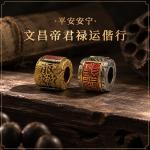
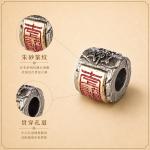
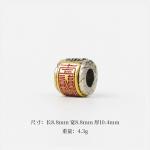
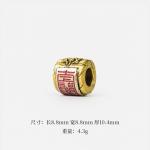
A straight-tube spacer is cylindrical with a through-hole, and its job is to divide the beads on either side of it. The runes are cut around the body, and the first and last must meet, or a full turn of the bead shows a break in the text. Casting a tube calls for an even wall; a thin wall dents. You cannot see the wall, so weigh the piece in the hand and put back anything that feels too light. The characters need air between them; packed tight, they stop being legible. And if the tube is slightly oval it will rock on the cord, so turn it as you inspect it.
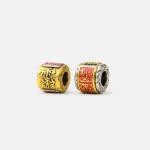
Two colours, yellow and white. The white is the natural alloy, cool and restrained; the yellow is warmer, closer to old bronze. For an object that belongs to a scholar, plainer is better — the white wears well, while the yellow stands out on a desk. The cords differ too: white with grey or navy, yellow with brown or ink green, and either pairing will be inoffensive. The yellow is not plated; it is the colour of the alloy, and it will darken with wear rather than flake.
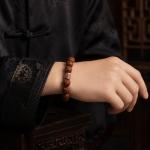
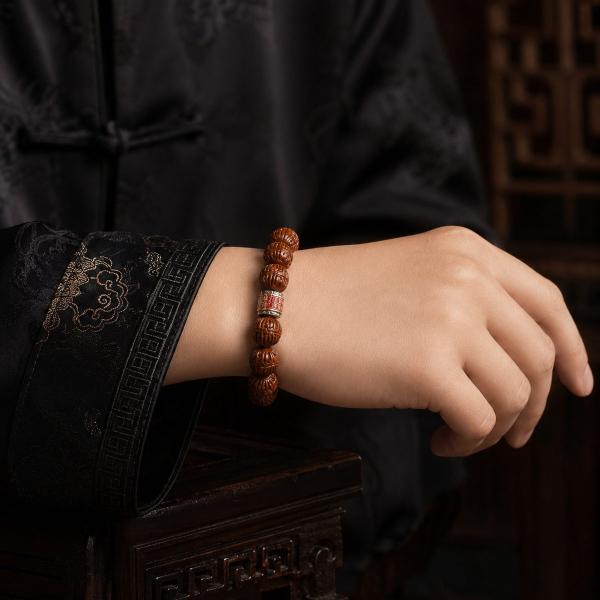
The spacer should be half a size smaller than the main beads so that it does not take over the position. Wenchang strands are often built on plain beads such as star-moon or phoenix-eye, and the metal in the middle gives the texture a step down. With a fine hole, use a flat cord, because a round one bunches at the mouth. One per strand is enough; two look like weights. If the ends are not square, the neighbouring beads tilt and the whole strand goes crooked with them.
In households with an examination candidate, this sort of piece sells. Keep the talk practical: Wenchang is a symbol of scholarly honour, and study still depends on the student. A keepsake, a small object for the desk — both are fine. Do not say that wearing it guarantees a pass, which is gambling with someone’s future. If a parent insists on something efficacious, send them to a Wenchang pavilion, which is more use than a purchase. And for a student, plain packaging is better; anything elaborate is a distraction.