


Menu
By theme
By theme


{{ variable.name }} : {{ variable.values[selectedVariantsIndex[variable_index]].name }}
Quantity:
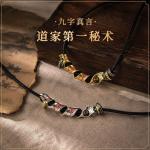
The nine-syllable mantra is lin, bing, dou, zhe, jie, zhen, lie, qian, xing, and it comes from Ge Hong’s Baopuzi, in the chapter on entering mountain country. The text calls it the secret invocation of the Six Jia and says that reciting the nine syllables on the way into the hills will keep off tigers and wolves and repel ghosts. It began as a protection for travellers in the mountains, which is not what the films have made of it. Ge Hong was a man of the Eastern Jin, and the book deals with alchemy and technique; the words can still be checked. There are many editions of the Baopuzi and they differ in small ways, so it is safer to say that the editions agree in substance.
Carried to Japan, the syllables shifted slightly in order and in one character, becoming “arrayed before,” which is a separate branch of transmission. Old Chinese pieces still read qian xing. Provenance sometimes shows in exactly that kind of one-character difference, and it cannot be hurried; you compare, slowly. A piece with the other reading was most likely taken from a Japanese printed edition. The Japanese branch also pairs the nine syllables with hand gestures, which is another subject again. Set the two traditions side by side and you can trace how the text travelled.
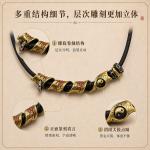
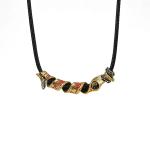
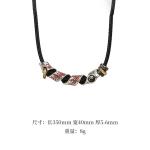
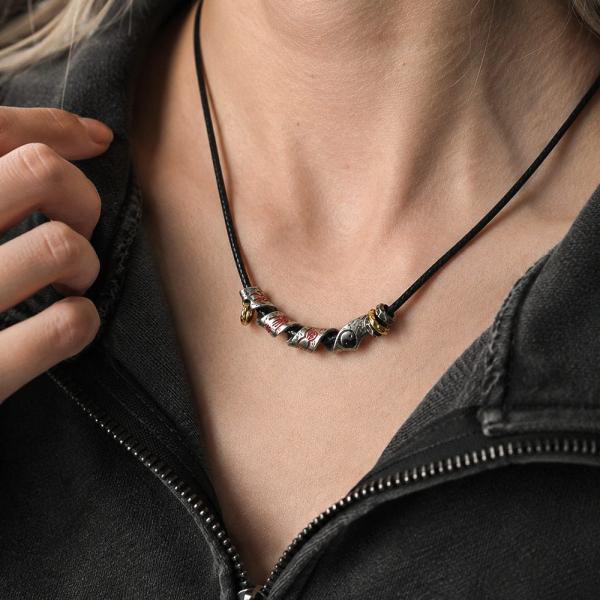
The scroll form borrows the look of a rolled sutra. There are axle heads at both ends and a scroll face between them, with the characters set vertically on the face. A pendant scroll must stay thin, or it becomes a brick, and the axle heads must be round or it stops looking rolled. If the face is curved, the characters have to follow the curve; straight columns break the flow of the text. And if the face is filled too completely, the white space is gone, and the feeling of a scroll goes with it.
Silver and gold versions. In silver the alloy is natural, the cuts are polished, and the face is left matte, so the contrast is what makes the characters legible. The gold is warm and looks well on a dark cord. The difference between them is colour, not workmanship, so choose by what you normally wear. The gold shows wear more obviously, and on a damp hand you should expect it. Its colour is at the surface, and where the edges rub, white will show through — that cannot be avoided.
The hole usually runs horizontally, with the cord through both ends so that the pendant hangs crosswise. Crosswise, it lies flat against the chest and does not turn over; hung vertically it will rotate, and needs a knot to hold it. Use a fine chain, since the scroll itself is not heavy. When giving it, you can say that these are nine characters recorded by Ge Hong, which is a clear provenance and carries some weight. If the recipient has read the Baopuzi, nothing more needs saying. The piece is light enough that a fine chain does not drag at the neck, and it is comfortable in summer.