


Menu
By theme
By theme




{{ variable.name }} : {{ variable.values[selectedVariantsIndex[variable_index]].name }}
Quantity:
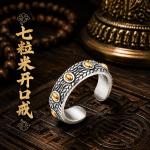
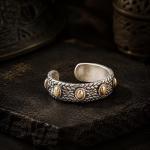
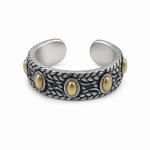
The name seven grains refers to seven raised grains of rice on the face of the ring, set one after another. On a narrow band this arrangement is the most flattering: no large motif, just a row of close-set bumps that gives a strong granular texture as light passes over it. At a distance it is a bright line; up close you can count seven. That is why it holds the eye. The face is narrow, so carving deep would dig into the finger and carving shallow would lose the form. The spacing of the seven has to be even, or it looks like a missing tooth.
The pixiu is an auspicious beast of folk legend. In early texts pi and xiu were written separately and later merged into one animal whose image settled over time: one or two horns, a beast's body, a curled tail and a wide-open mouth. From the Ming and Qing onwards the figure appears on objects in great numbers, in jade, brass and wood. It belongs to legend rather than to Buddhist iconography, and the two should not be told as one story. Later generations have added many tales to it; hear them and leave it there. On brass pieces the pixiu is usually just the head, with the body left out.
White copper suits this kind of fine granulation because it is hard enough to keep the edges of the grains from rounding off. The drawback is that the gaps between them collect dirt, so wipe the ring after washing your hands or using hand cream, or it will darken within days. The sharper the grains, the more they catch knitwear, which is a common complaint with narrow bands. Edges that are too sharp mean no chamfer was cut.
Which finger you wear it on decides how often it is seen. The index finger is the most conspicuous and suits a strongly textured design; the middle finger is steadier and least in the way day to day; the ring finger looks good with a plain band and feels crowded with a raised design like this. If your knuckles are broad, choose an open band or a curved inner face, which goes on and off more easily. Measure your ring size in the afternoon, since fingers are slimmer in the morning.
In the catalogue this sits with the pixiu pieces, which is about where the motif comes from and nothing more. After a while the whole ring dulls and the tops of the grains polish bright first, creating a contrast of light and dark that people who like this sort of thing enjoy as part of owning it. Store it separately when not worn rather than with hard objects, because a chipped corner on a grain cannot be repaired. White copper takes on a slightly warm tone with age, which is not dirt.