


Menu
By theme
By theme

{{ variable.name }} : {{ variable.values[selectedVariantsIndex[variable_index]].name }}
Quantity:
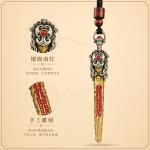
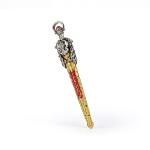
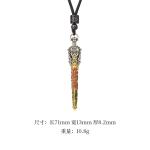
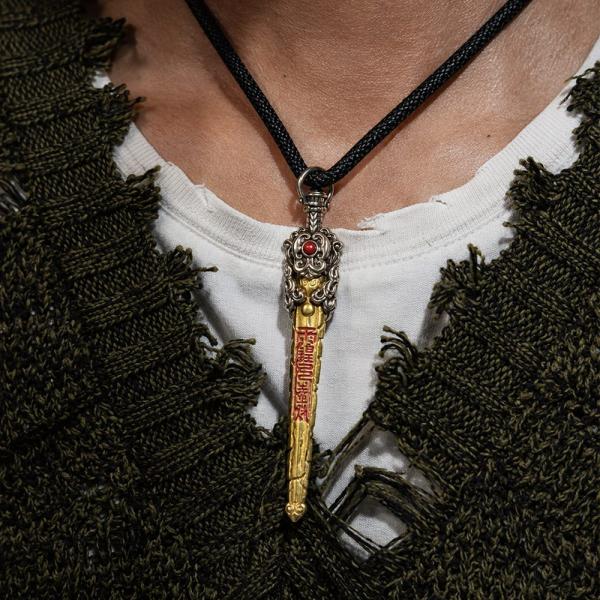
Among Daoist ritual implements the sword ranks near the front. The tablet issues the command and the sword carries the execution, and the two are often used together. A ritual sword does not look like a weapon: blade narrow, guard wide, the pommel often worked as a cloud head or a beast mask, and a ridge line raised along the blade — the point is stiffness, not sharpness. Stand it on a desk and what you look at is the ridge, not the edge. The cloud head at the pommel has its rules: the feet of the cloud drawn in, the head open, never smeared into one mass.
“Old method” means the antiqued finish. New brass is too bright, so it is bitten in a bath, then worked with a cloth wheel that lifts the high points and darkens the hollows until it looks used. Done well, the corners of the guard are bright and the groove of the blade is dark, and light gives it depth. Done roughly, the whole piece is one tone, like a coat of paint, and the longer you look the falser it seems. The depth of the antiquing has to be even as well; deep here and shallow there looks scorched, which is merely dirty.
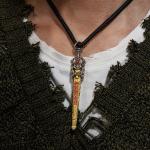
A sword-shaped pendant carries more taboos than other subjects. The old saying is that a weapon does not point at the body, so it is worn tip down or turned outward, and the edge never faces the chest. That is a preference, not a rule, and those who hold with it simply do it. Others say the opposite — tip down is “sheathing the edge”, meaning harm to no one — and both accounts get told, and both sound reasonable. Choose a dark cord; a pale one is too loud against a sword shape and shows dirt, and one cord lasts a year.
The sandalwood-cord version is the easy one: the cord comes with it, running dark brown, in the same family as the warm brass. With the pendant alone, mind the thickness — a sword piece is wide at the top and narrow below, so a thick cord bunches at the pommel and a thin one cannot hold it; take the middle. Knot behind the grip so the blade hangs straight. Sandalwood cord fears water, so push it up the wrist when washing rather than leaving the end soaking in the basin.
As a gift, a ritual sword is not a pleasing subject and the recipient has to be chosen. For someone who designs or adjudicates, the theme is decision; for an elder, it is holding the house. Do not give one to the newly married — the imagery does not sit with a wedding. Some customers hang one in a study, saying it keeps them alert, which is a fair use and steadier than a car, and quieter. If it needs a meaning, in Daoism the sword cuts, and what it cuts is scattered thought. Keep sword shapes away from a keyring; the tip is what blunts first, and blunted there is no edge to see.