


Menu
By theme
By theme




{{ variable.name }} : {{ variable.values[selectedVariantsIndex[variable_index]].name }}
Quantity:
The nine-syllable mantra comes from Ge Hong’s Baopuzi, in the chapter on crossing mountains and fords. The text says that to enter the mountains you must know the secret invocation of the six jia, and the invocation is nine syllables: lin, bing, dou, zhe, jie, zhen, lie, qian, xing. Keep it repeating silently and you will not run into anything unclean. It stands in that chapter because it was written for people walking mountain roads, and only later moved elsewhere. Tigers, wolves, poisonous insects and forking paths were all, to the old mind, the work of malign vapour, and saying these syllables was a way of steadying yourself.
The nine are recited in four groups, the first four with a pause, the last five in one breath. In Daoist practice the recitation is silent — a secret invocation — and a voiced version is chanting, not reciting. The rules differ by school; what they share is that it must be slow. Rushed, the syllables stick together and you cannot hear yourself, let alone remember them. The hand gestures have their own rules and differ by school; they are not set out here, because a written description is more likely to teach them wrong.
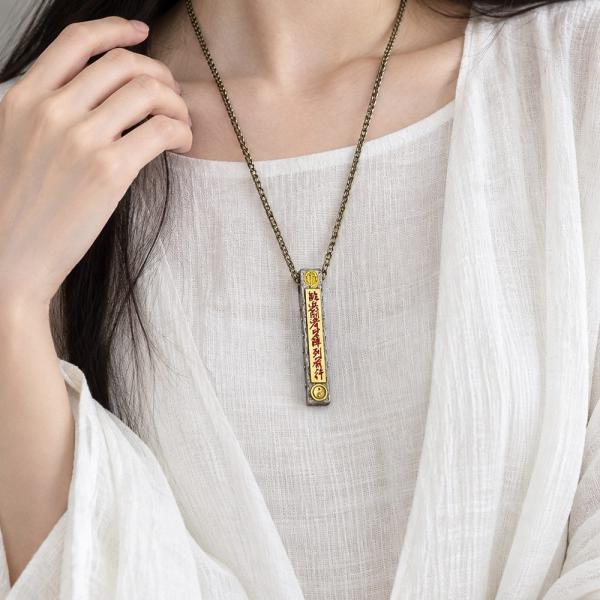
A square tube is harder to lay out than a flat plaque. All four faces have to be accounted for, which face carries which characters and how the white space is divided, and the flat pattern is drawn before any work starts. Walls too thin collapse, too thick look clumsy, and a difference in weight is felt at once in the hand. If the characters run around all four faces, the two turns need breathing space or the characters collide. The depth of the cutting has to be consistent: deep holds dirt, shallow does not read, and every batch loses a few pieces.
The three versions differ in how they hang. The chained one goes straight on: the chain is thin, the tube slides along it, and the position is never fixed, though the advantage is that turning your neck does not pull. The tube alone takes your own cord, and the knot catches at the mouth so the position is set. On the auspicious-cloud cord, cloud pattern is braided in, dressing the piece to match the characters. Set the knot just above the mouth of the tube, so the tube does not hang low.
This kind of character piece sells on a Buddhist-leaning counter, and most buyers are not Daoist priests. Whether they recite is beside the point; what matters is that the meaning is explained: the nine syllables are an old protection charm, not a wish-fulfilment charm. When someone asks whether it brings wealth, say plainly that it is not for that, and being plain makes them trust you more. Belief is a private matter, and there is no chasing people around the counter with questions. Use waxed cord rather than nylon: nylon slips, knots will not hold, and the tube comes off. Anyone who has lost one comes back for waxed cord.