


Menu
By theme
By theme


{{ variable.name }} : {{ variable.values[selectedVariantsIndex[variable_index]].name }}
Quantity:
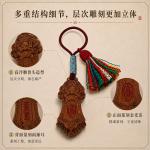
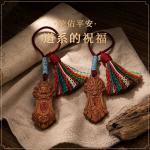
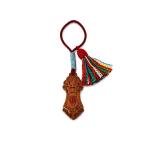
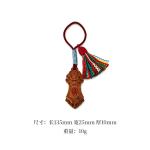
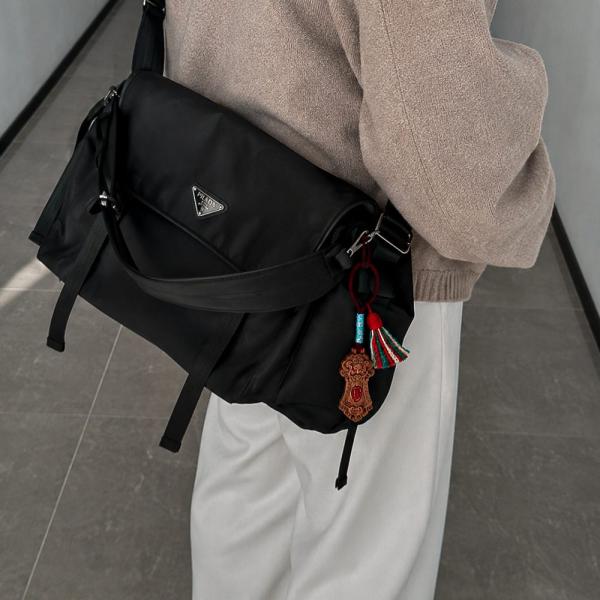
The head of a sword’s grip is the pommel, and on old swords it is often worked as a beast mask: a face looking straight ahead, eyes protruding, brow ridge pressed low. Made into a hanging charm, that face becomes the front and the blade shrinks to a section below it. The weight of the whole object is in that face. Beast masks are commonest on sword fittings from the Warring States into the Han, in jade and in bronze, and later sabres carried the practice on. Blade length is set by the piece: too long and it stops being a fitting and becomes a small knife.
A beast mask lives or dies on brow and nose. The brow ridge should stand high, the eye sockets deep, the bridge of the nose a straight line down. Cut shallow and it becomes a human face; cut too far and it becomes a demon. That measure is in the carver’s hand and cannot be marked on a drawing. The horns vary as well — ox horn, goat horn, cloud head, each a line of its own. Leave the pupil a half-sphere and let the highlight work, which wears better than an incised ring. In the mold the brow ridge has to be deepened separately; it cannot be done in one pass.
The secret name character of Ziwei goes on the blade, a single character set vertically, taking little room. A blade is narrow to begin with, so the character has to be lean, with few horizontal strokes, since more of them smear. This narrow vertical setting and the square setting on a plaque are two different skills; someone who can cut a plaque cannot necessarily cut a blade. Leave a gap between the character and the beast face — crowded together, neither reads.
A blade made as a fitting does not need to be comfortable to wear; what matters is where it hangs. At the side of a strand, tip down is the only way it sits right; at the back-bead position the blade has to lie flatter, or it digs into the nape. The hole is most secure at the top of the pommel; set in the side, the blade will always lean. If the hole is below the top of the pommel, the blade will not lie flat and will swing.
These sell mostly as an afterthought, added when a strand is being put together. Customers choose their beads first and only remember at the end that the strand needs a closure. Keep them where they can be seen on the counter, and a word about tip down does more than a speech about auspicious meanings. Customers pairing with silver tend to choose a plain beast face, those pairing with wood a cloud pattern; each has its line. Price by the piece, not by the pair, since few buy two. Size follows the main bead: a large main bead wants the next size up, and if the fitting cannot hold its own the pairing is wasted. A blade fitting sells a handful a year, but without it the strand has no ending.