


Menu
By theme
By theme

{{ variable.name }} : {{ variable.values[selectedVariantsIndex[variable_index]].name }}
Quantity:
North of Lhasa stands Zhaji Temple, and what it houses is Zhaji Lhamo. People who go there to ask for money do not carry incense; they carry baijiu. At the door they offer a khata first, then hand over the bottle. The scene is uncommon in Tibetan monasteries and first-time visitors tend to freeze for a moment. The temple is small and the courtyard narrow, but the queue runs from morning to night, and longer on holidays. No brand is asked of the liquor; bulk spirit is accepted too.
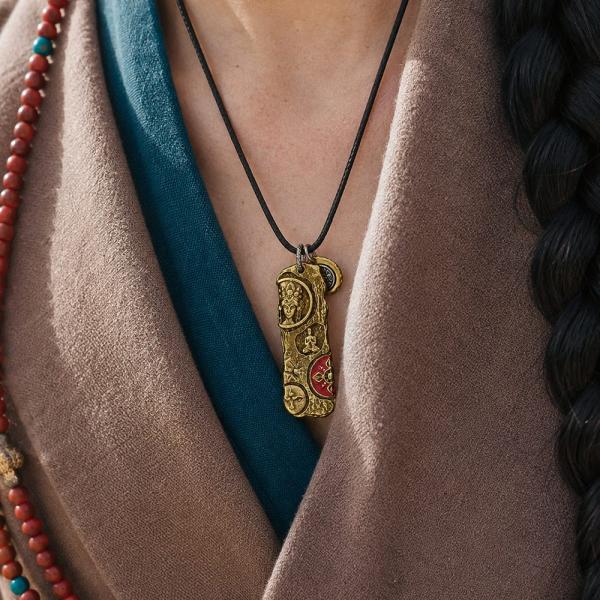
Accounts of where she comes from differ. One says she was a Han woman who came to Tibet with Princess Wencheng; another says she was a protector brought by inland trading caravans and simply stayed in Lhasa. The figure has a black face, a tongue out, a crown, and looks neither like a Han deity nor entirely like a Tibetan protector — recognisable at a glance to anyone who knows her. Tibetan protectors are mostly wrathful, and she is one of the rare ones who is both fierce and a little worldly, so that after a while she stops being frightening.
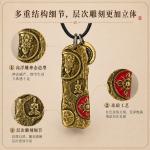
“Double-joined” means two plates made into one. The front carries the figure, the back is the base, and the two are fitted together with the rims gripping. The advantage is that the front can be raised high without the back limiting it; the difficulty is the seam, which shows if it is wide and opens at a touch of the polishing wheel. That is why double-joined pieces always cost more than single plates. The rim needs a lip as well, so the two halves grip; glue alone will not hold for years.
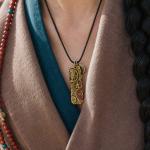
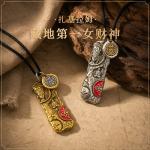
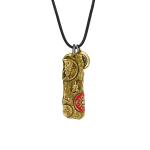
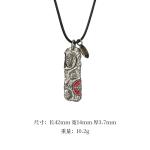
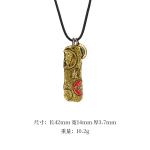
Gold and silver are the two plating colours. Gold is bright and presentable for a festival; silver is plain and does not draw the eye day to day. The two versions with sandalwood cord are for people who do not want to choose a cord, and the dark cord sits well with the black-faced figure. Sandalwood cord has one fault: in summer sweat it bleeds a little colour, so watch a white shirt collar. Gold goes with dark clothing, silver with light, and a comparison at the counter settles it.
The wealth-asking subject has its own grammar in Tibet and in the Han heartland, and Zhaji Lhamo has only become popular inland in recent years. Most buyers have heard a story about her answering prayers; at the counter I do not take that up, and talk only about provenance and making, which reads as steadier. When someone asks whether they should offer liquor, the answer is “that is how it is done at the temple; at home, as you like”. Some treat it as a protection plaque, some as a Tibetan ornament pure and simple, and both sell. Many ask the price; those who actually buy have usually been to Lhasa, and nod as soon as they hear where it comes from.