


Menu
By theme
By theme


{{ variable.name }} : {{ variable.values[selectedVariantsIndex[variable_index]].name }}
Quantity:
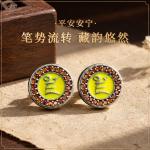
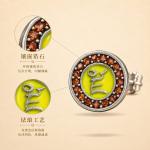
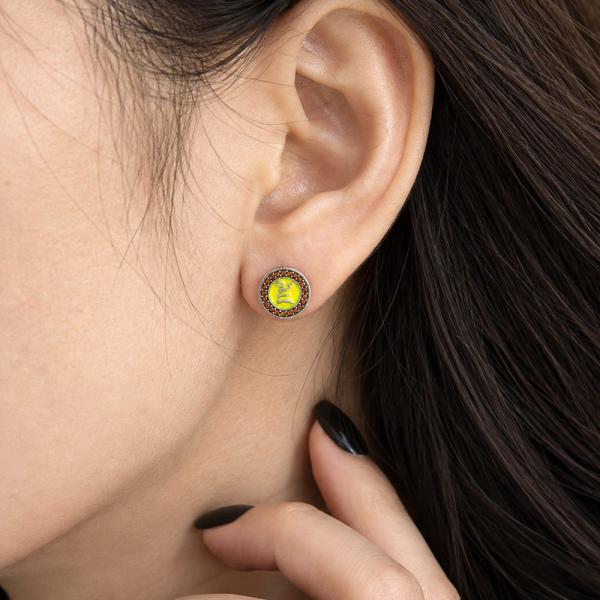
Yellow Jambhala is a wealth deity of Tibetan Buddhism, one of the five Jambhalas, yellow in body, a wish-fulfilling jewel in his right hand and a mongoose spitting treasure held in his left. A stud earring is no bigger than a fingernail, far too small for a figure, so only the heart mantra is taken: a ring of Tibetan script set around the centre. Few customers read Tibetan; what they judge is whether the ring sits evenly. The mongoose holds a jewel in its mouth — a detail clear enough on a full statue, reduced to a dot here.
The face is round, so the characters follow the circumference and narrow towards the rim; each one has to be adjusted in width by hand. Copper is softer than white copper, which makes incising easier, but the cut edges fur up and a careless polish blurs them. On pieces this small, legibility is what separates one grade from another. Blur it into a smear and from a distance it is only a circle. A thin border should be pressed around the rim to keep the characters off the edge — clipped in half at the boundary, they look bad.
The post is S925 sterling silver. Anyone whose ears inflame easily buys on the strength of that post. Silver is soft, so do not bend it sideways putting the earring on; bend it once and it is out of true, and straightening it again is likely to snap it. Silicone backs are kinder than metal ones and do not dig in if you fall asleep wearing them. Check the joint between post and face and reject a loose one. Silver dislikes sulphur — rubber bands, wool and camphor will all turn it black, so store it away from them.
The copper body has a smell to it, stronger once you sweat; wipe it when you take it off and that is the end of it. Do not dip it in silver cleaner — the stuff is brutal on copper and leaves a pink film. The studs are light, so the lobe will not stretch over time, which is more than can be said for big hoops. Keep them in a small pouch, the two separated so they cannot rub. Their weights should match; a real difference means one was cast short, and you can feel it holding one in each hand.
Worn as a pair, the two may not run the same way, since the script goes round in a circle; if that would bother you, compare them at the counter. The subject is Tibetan, and it is worth saying so plainly rather than sliding it towards Chinese wealth gods — two different systems, and mixing them invites mistakes. If nobody asks, there is no need to hold forth. The mantra is chanted differently from one tradition to the next; the characters here follow the received text, with nothing added or dropped. Add a syllable and it is no longer the mantra.