


Menu
By theme
By theme

{{ variable.name }} : {{ variable.values[selectedVariantsIndex[variable_index]].name }}
Quantity:
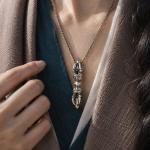
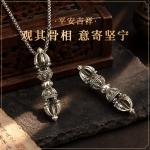
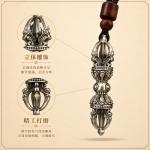
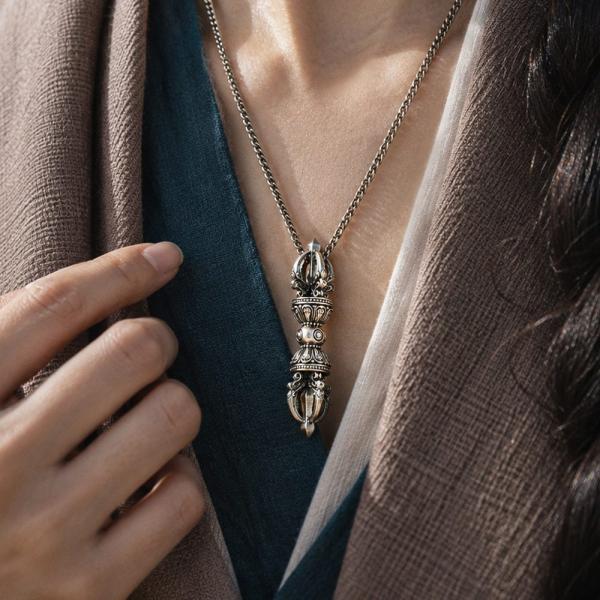
The vajra began as a weapon in India and later became a Buddhist ritual implement. The five-pronged form has a central shaft with four more curving out around it, all tapering to points, and where they meet the mass reads as a full round hub. The five prongs answer the five Buddhas of the directions and the five wisdoms; that much is rule in iconography, not something read in later. Held in the hand, the first thing to check is whether that hub is full. The centre shaft should be a little thicker than the four around it; thicker and it stands, and at equal thickness there is no principal and no subordinate.
A vajra is a solid object; made into a pendant it can only be flattened halfway. What collapses first in the flattening is the gap between the prongs, and the mould needs enough metal there or the casting comes out as a lump. Look at it from the side: light should pass between the prongs. Where it does not, the metal has filled the space, and the boundary between one prong and the next has blurred with it. On a flattened vajra the back should be plain so the raised face reads; pattern on both sides pleases nobody. The waist at the middle has to be symmetrical — thick on one side, thin on the other, and it looks wrong however you turn it.
Antiquing earns its place on a vajra. Dark in the hollows, bright along the prongs, and the five separate; polish the whole thing and under a lamp five prongs blur into three. The hardness of white copper lets the points hold their shape through a knock without bending. If a point does bend, do not straighten it yourself: white copper is brittle and one bend will snap it. Workshops finish the points differently, some sharp and some rounded. Rounded does not prick; sharp has force.
The pendant hangs upright, weight through the middle, with the hole through the top point. The hole is small, so the cord must be fine. The vajra has edges and will press against skin; under thin clothing it sits better tucked inside a collar. It is heavier than a round plaque of the same size, so the chain should be a sturdy one. A Chopin link holds better than a thin cable and will not stretch in two days. It can be hung crosswise, but that needs a second hole, which is not normally drilled; hung sideways it tends to flip over.
On a vajra, the shape and where it comes from are enough. It is a ritual implement, not a decorative motif, so do not sell it bundled with warding off evil and drawing wealth. The aged colour lightens where it rubs, and the points brighten first, which is ordinary wear. Anyone who finds that too bright can touch it with a soft cloth and the least bit of oil; too much oil gathers dust. Some people want to string it on a vajra-knot cord, which is thick and will not pass the small hole; it has to be opened out first.