


Menu
By theme
By theme


{{ variable.name }} : {{ variable.values[selectedVariantsIndex[variable_index]].name }}
Quantity:
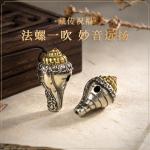
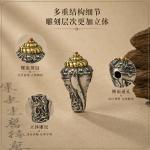
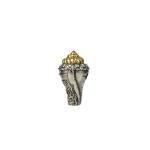
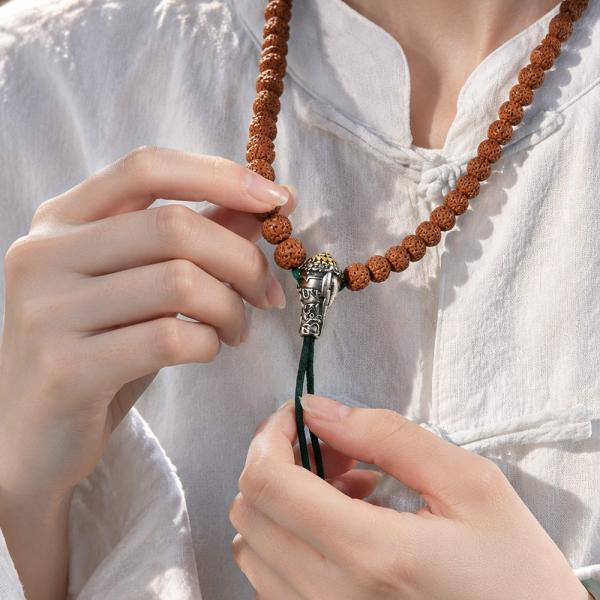
The conch holds one of the eight auspicious symbols of Buddhism, ranked behind the great umbrella, the golden fish and the treasure vase. Monasteries once used it to keep time: one blast of the horn carried down the valley and the monks knew to assemble. The right-turning white conch was the most prized, its spiral running clockwise, a refinement that travelled in from India and was copied straight into Chinese commentaries. The six-syllable mantra is Avalokiteshvara’s, cut into the shell itself. More people recognise those six syllables than can read them. The mouth of the shell faces outward, as it does on every old example of the pattern; turned inward it reads as buckled, stifled.
The three-hole bead is also called the Buddha head, and it sits where a strand closes. Three cords enter three holes, meet inside one bead and knot, and a small stupa is set on top; that section is the stupa head. The bores have to run true, and everything depends on the point where the three channels cross. That is the costliest part of the work: shift it a fraction and the strand hangs crooked, rolling to one side as it is wound. Cast cupronickel still has to be reamed hole by hole, with a small chamfer left at each mouth so the cord does not chafe through. A hole too small fights a doubled cord; too large and the bead rattles. Both ends get tested. Reaming dust has to be blown out, since left inside it saws at the cord.
Cupronickel is copper with nickel in it, silvery-white, bright without any plating. The gain is hardness: fine engraving stays crisp and does not slump the way pure copper does. The cost is brittleness. Knock it against a tile and it marks; drop it and it rings like porcelain. Left alone the colour deepens, and a heavy-handed wearer will see a season’s change in it, fingerprints included. That is how old copper behaves, not a fault. When it looks too dark, a silver cloth brings back about seven tenths of the brightness, and the little that stays in the recesses is the better half.
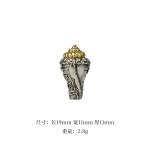
Most fittings are bought to finish a strand. One closes a bracelet, one a 108-bead mala, and some use it as the joint of a necklace. Large beads need a large guru bead, or the weight sits wrong and the piece flips the moment you look down. Measure your own cord first: doubled and single differ more than people expect, and waxed cord is thicker than elastic. If you are unsure, send a photograph of the cord; it is more reliable than a bead count. On the first stringing, do not knot anything. Hang the strand, look at the drop, and close it only when it hangs straight.
Pieces like this make no claims, and the shop does not have them blessed. What a customer wants is a shape and a piece of craft, and saying so plainly makes the sale easier. When it is off, wipe it dry with a soft cloth and put it in a pouch; do not throw it in with keys, because copper is more fragile than it looks. For a dull face, wipe the silver cloth one way only, since back and forth just fogs it. Dust in the engraved grooves comes out with a toothpick, never a needle, because one slip of a needle is one scratch. Take it off before a shower; soap left in the seams turns it black.