


Menu
By theme
By theme



{{ variable.name }} : {{ variable.values[selectedVariantsIndex[variable_index]].name }}
Quantity:
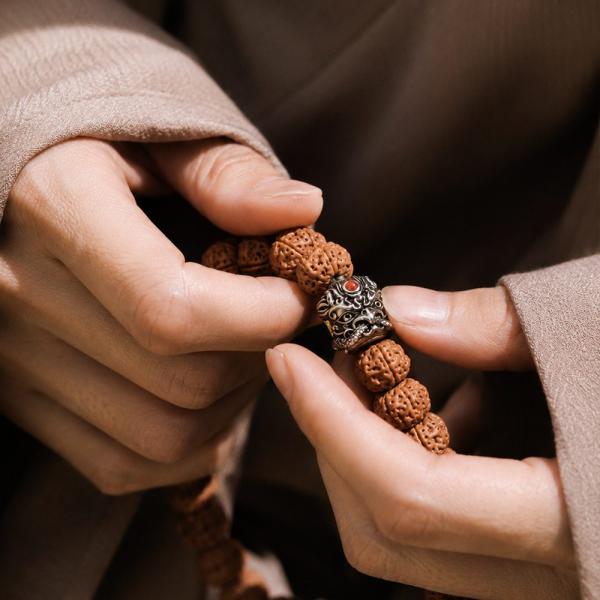
A spacer’s job is to separate two main beads. Hard bead against hard bead chips at the hole, and something in between takes the shock. It also fixes position: one every so many beads gives a long strand a rhythm under the fingers. The bore must run true and be chamfered at the mouth, so the cord can turn inside without being cut. It has to sit dead centre; off by a little and the whole line twists. Metal is heavier than wood, so too many of them and the strand lists to one side.
In Tibetan Buddhism the garuda is called khyung, and Chinese renders it as the golden-winged bird. Its source is the Indian Garuda, which fed on nagas and was later absorbed into Buddhism as a protector. Images usually show spread wings on a human body with a bird’s head, the wings wider than the body, a naga pinned under the claws. Chinese usage mixes it up with the peng bird, though the lineages are different. On Tibetan thangkas it is usually painted above the Buddha figure, in a very fixed position.
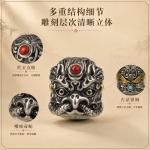
The wings are thin and the hardest part to cast full. A wingtip short of metal ruins the piece. The mould cutter thickens the root of the wing, invisible to the eye and slightly solid under the finger. Feather lines are pressed one at a time; too shallow and they smear together, too deep and wax pools in them. The eyes and beak carry the expression, and a blunt beak loses the fierceness. The back is usually flat, so it lies against the bead without rubbing the cord.
Tibetan strands are built on colour, red and yellow first, with the cold of cupronickel between them as a divider. The garuda usually sits below the top bead, or one on each side in symmetry. Too many weigh the hand down; two or three places in a strand is enough. A metal piece between wooden beads keeps the oil of the wood off the copper. Southern red agate and amber both hold their own; with turquoise, pick the shade, since pale green is flattened by the cold metal. One cupronickel piece between red and yellow keeps the colours from muddling, and no strand needs more than three colours.
The face is fierce and plenty of people dislike it, which is normal. It protects the dharma, not a particular person; say that clearly and the customer decides for themselves. The surface comes bright or darkened. Dark hides fingerprints, while bright shows every scratch as a white line. Darkening is an extra step, colour sunk into the hollows with the highs left bright, so it feels slightly uneven under the thumb. Worn long it goes black; a wipe brings it back, and no oil is needed.