


Menu
By theme
By theme


{{ variable.name }} : {{ variable.values[selectedVariantsIndex[variable_index]].name }}
Quantity:
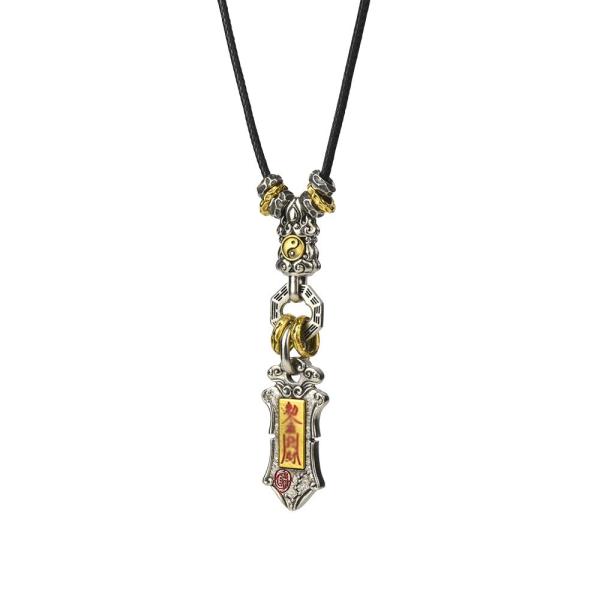
Shan Gui began as a piece in the Nine Songs of the Chu Ci, a sacrifice to a mountain spirit. Qu Yuan’s mountain ghost is a goddess draped in ivy and mistletoe, and the poem is tender, nothing like the fierce deity she later became. Folk practice moved her into the work of warding off evil and cut her onto charm coins, a spell on one face and the bagua on the other. The spell usually opens with Shan Gui and closes with "as the law commands", borrowing the tone of an official document. Charm coins were not currency. They were for protection, hung on the body or sewn to a curtain.
The bagua is arranged two ways, Earlier Heaven and Later Heaven, with different sequences and different directions. A small plaque usually takes the Earlier Heaven order, Qian south and Kun north, which reads more easily. The yin-yang fish sits in the middle and the eyes cannot be left out; without them it is two blocks of colour. The cut lines have to be an even width, because vary it and the trigrams are misread. Eight trigrams ring the centre, and half a grid out of place is obvious to anyone who knows the form.
A square plaque lays out a picture better than a round one. The four corners hold their ground, so the ring of trigrams lands complete instead of losing a line to the curve. Cast cupronickel has to be flattened, since a warped face rocks against the chest. The back is usually left plain, because engraving there would dig in. Edges get rounded; sharp corners look well and ruin clothes. Thick feels substantial and thin feels alert, so take the middle. Casting porosity hides in the corners and is filled while the piece is finished.
This kind of plaque is not made for wearing against skin. The metal is cold, and in winter it bites for the first moment; once you sweat, verdigris transfers to a collar, so watch pale clothing. Wear it outside a sweater, or through a layer of cloth, and the problem goes away. Choose a heavier chain, because the plaque has weight and a fine chain pulls straight. The raised bagua lines press marks into skin after a long day. In summer, blot it dry when you get home rather than leaving sweat on it overnight.
Shan Gui and the bagua are both old motifs that anyone may use; there is no exclusive. If someone asks whether a Daoist priest drew this one, or whether it was offered in a temple, the answer is no on both counts: it is made after traditional patterns. Saying so plainly prevents arguments later. Some people are frightened by the word gui, ghost. Originally she was a mountain spirit. The name is alarming and the origin is not, and that is worth telling a customer. The price reflects the work, not the magic.