


Menu
By theme
By theme

{{ variable.name }} : {{ variable.values[selectedVariantsIndex[variable_index]].name }}
Quantity:
Green Tara is one of the twenty-one Taras of Tibetan Buddhism, green in body, and she stands for speed of action. Her usual posture has the right foot stepping out, as though she might rise at any moment to go to someone’s aid. Older Chinese translations call her Duoluo Bodhisattva; a different name for the same figure. One widely told account of her origin has her born from Avalokiteshvara’s tears. In Tibet she is the swiftest to answer, and the one most often called on in trouble. The twenty-one each hold a department, and hers is rescue, which is why her incense is the thickest.
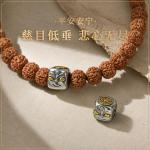
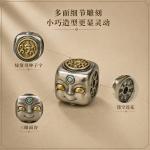
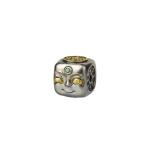
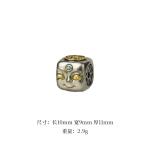
A square guru bead costs more work than a round one. Four faces have to be trued and the edges broken, or they cut at the neck. The three bores meet in the centre, and the walls between them are thinnest there: one slip on the drill and it breaks through. The mouths get a small flare so the cord runs clean. Tilt the blank and the three holes no longer sit in one plane, and the strand hangs twisted. Edges are filed in one direction only, since back and forth rounds off the corners and the square piece is finished. All four edges must be the same width, because an uneven one looks hand-corrected at a glance.
Cupronickel is hard enough that the edges of a square piece hold, and it does not dent the way pure copper does. Polishing goes from coarse to fine, leaving a line of brightness on the edges and a satin face, and that is what gives it depth. A full mirror polish looks cheap, like plating. The Tara’s face is small; eyes and brows are cut lines, and a little deep turns fierce while a little shallow turns muddy. Robes can be simplified. The face cannot.
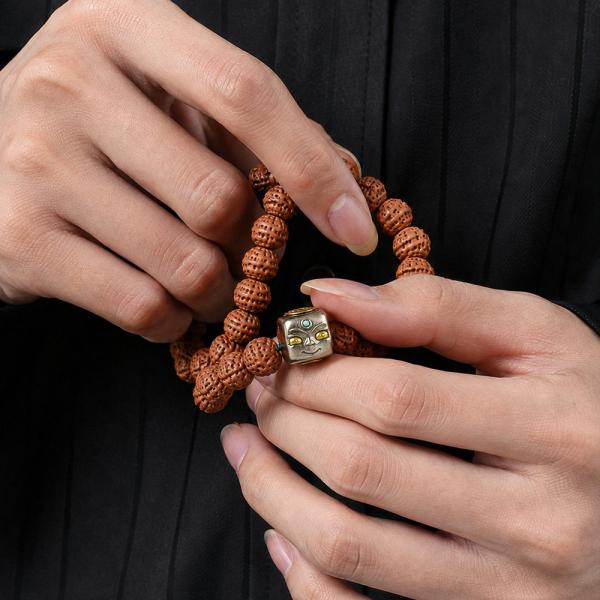
It suits bodhi beads and wooden beads equally. Set at the closure of a long strand, a square guru bead reads as a seal and sits more steadily than a round one. Small beads take a small square piece, or the proportions go off. Measure the bore before stringing, since forcing it rubs the colour off the mouth. Leave a little slack in the closing knot, because cord shrinks with use. A square piece has four faces and turns differently under the fingers from a round one, and some people choose it for exactly that.
The shop does no ritual over pieces like this and has no temple connection. If a customer asks, say it is a copper fitting and the motif comes from tradition. What they want is a marker to carry, and that meaning does not need anyone’s stamp. Some will compare it with a far more expensive piece elsewhere, ten times the price and not the same object. Explain the difference and let the buyer choose. A copper piece is a copper piece: good work, pleasant to wear, and that is enough.