


Menu
By theme
By theme






{{ variable.name }} : {{ variable.values[selectedVariantsIndex[variable_index]].name }}
Quantity:
A spacer bead is a pause in a strand. When every bead is the same, the eye tires of it; add one of another material every few beads and the gaze has somewhere to rest. A spacer cannot be too large or it competes with the main beads, and cannot be too small or it disappears. With the right proportion the rhythm of the strand runs smoothly. The material should differ from the main beads, because the same material in the same colour means you have added nothing at all. Brass with wood, or brass with bodhi, is the safest pairing.
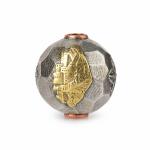
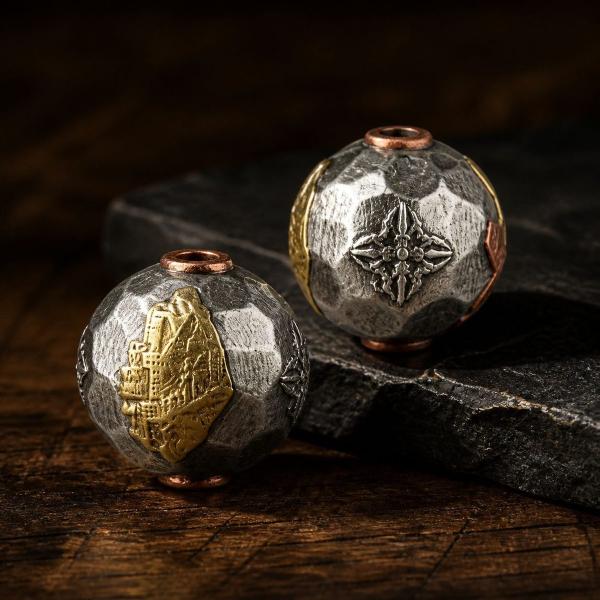
The Potala Palace stands on the Red Hill in Lhasa. It is a Tibetan palace-fortress in two parts, the White Palace and the Red Palace: the White Palace has whitewashed outer walls, the Red Palace sits centrally and higher, and the colour contrast is strong. The whole building steps up with the slope, its windows small and densely set, its walls clearly battered. Shrunk onto a single spacer bead, only the outline and a few windows can survive. The White Palace was the living and working quarter, while the Red Palace holds the chapels and reliquary stupas, which is the difference between the two. On a bead this small none of that can be told; only the silhouette can.
The hardest thing about miniature architecture is proportion. Carve too many windows and the surface fragments; carve too few and it is no longer recognisable as a palace. The batter of the walls has to be there too, since vertical walls make it a plain block. The point of this subject is the silhouette, and when light falls across it at an angle you know at once whether the outline is right. The windows are usually reduced to a few horizontal lines with no frames, which reads better at a distance. The base should be flat, because a spacer that is not sits crooked on the cord.
How many spacers you use depends on the length of the strand. A wrist mala usually takes two to four, placed at even intervals between the main beads rather than pushed in wherever they fit. A longer strand can take more, but they should be grouped, two or three at a time, since scattering them looks random. The hole should match the main beads, and a spacer hole that is too small is a common problem. Spacers and main beads rub marks into each other, so if that bothers you add a thin leather washer, though not a plastic one, whose colour will be wrong.
Brass spacers polish bright with use, most obviously on the sides that touch the main beads, which is normal. To even it out, take the strand apart now and then and swap the spacers around. If verdigris appears at the mouth of the hole, wipe it off with a soft cloth rather than letting it build up inside. Do not oil it: brass attracts dust, and oil turns that into a sticky film. Store it with the main beads rather than leaving it loose in a drawer.