


Menu
By theme
By theme


{{ variable.name }} : {{ variable.values[selectedVariantsIndex[variable_index]].name }}
Quantity:
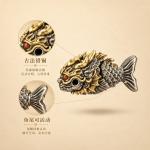
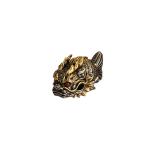
The fish-into-dragon story comes from the Dragon Gate. Old texts say that carp from rivers and seas gather below the gate, and that those which leap it become dragons while those which fail fall back. The image was later used for examinations and promotion, and for a person whose fortune has changed. The gate is at Hejin in Shanxi, where the Yellow River narrows and runs fast, and the story is recorded from the Han. In the pattern the head has already become a dragon while the body still carries scales, and that halfway state is the point.
The ageing sits on the scales. Dark in the seams, bright along the backs of the scales, and each one can be counted. The transition from tail to dragon head is the hardest: hurry it and it looks like a fish head stuck onto a dragon body, ease it and the transformation shows. The whiskers must be fine, since thick ones look like two wires. The spread of the fins sets the movement, and spread too wide and the piece scatters. Ageing varies piece to piece, light ones crisp and dark ones heavy, according to taste. The back usually carries water ripples, which fills the space and lowers the centre of gravity.
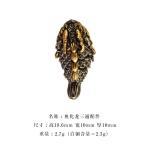
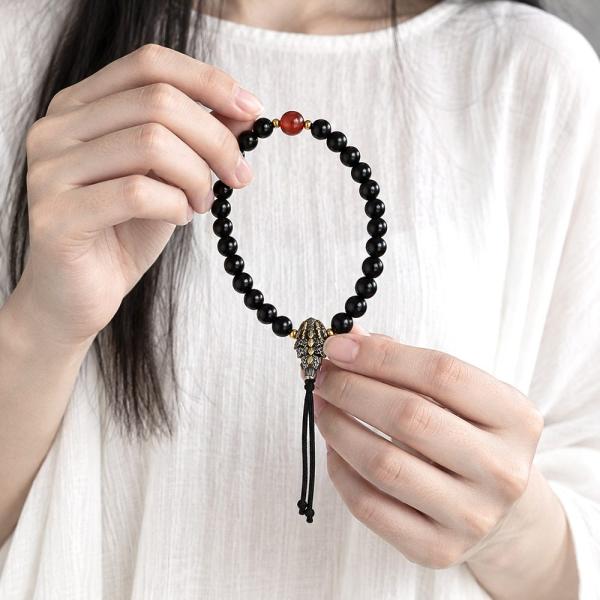
The opening sits behind the belly, where the three cords separate. The bores have to avoid the high points of the scales, or the cord is cut against their edges. The metal is thick, so the holes can be larger and a heavy cord passes easily. The three channels meet in the belly where the wall is thinnest, so drill slowly. Chamfer the mouths and the cord turns cleanly. Head outward, holes hidden under the belly, is how most people set it. In a heavy strand the guru bead takes the load first, so go one size up on the cord. Shift the hole slightly and the strand hangs crooked, so sight along it against a lamp while reaming.
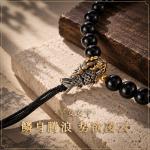
In a strand it usually goes at the closure with the head outward. It suits a student sitting exams, or someone who has just changed trade, since the carp leaping the gate needs no explaining. Don’t say it guarantees success, because saying too much only embarrasses. Dark wood sits steadily with it; with pale beads the brown of the copper overpowers them. One per strand is enough, or the theme scatters. The aged finish also looks well on a red cord, though the cord shouldn’t be thick enough to compete. The closing knot hides behind the belly, so no cord end shows. When the cord wears through, replace it before the pendant is lost.
An aged face dislikes sweat, so worn against skin in summer it mottles within days. Wear it outside clothing, or through a layer. Wipe only the raised parts and leave the dark in the hollows, since that is the ageing. Dust in the scale seams comes out with a soft brush, not a needle. Bag it when it is off, apart from other copper, because scale edges flatten at the first knock. Some find the fish-dragon odd-looking; that is unfamiliarity with the pattern, and it settles once you see it. The price reflects the scale work: pressed one at a time is not the same as cut one at a time.