


Menu
By theme
By theme



{{ variable.name }} : {{ variable.values[selectedVariantsIndex[variable_index]].name }}
Quantity:
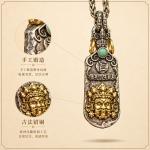
Yellow Jambhala comes first among the five Jambhalas, and his form is easy to read: chest bare, belly full, a wish-fulfilling jewel balanced in the right hand, a mongoose tucked into the crook of the left arm. What the mongoose spits is treasure, not coin, a distinction that gets muddled often. The plaque keeps the three elements apart: the jewel to the right, the mongoose at the left flank, and the belly left as one flat plane so the rise of the relief is spent on those two points while the face stays shallow. Each of the five Jambhalas governs a domain of his own; Yellow Jambhala's is wealth. That much is worth knowing.
Copper inlay is not the same thing as gilding. A shallow channel is cut along the pattern, a sheet of copper in another colour is set into it, filed flush, then ground back; the two metals bite into each other and the seam reads almost level under a finger. White copper for the ground, brass for the lines, and the colour split is wide enough for brows and robe folds to stand. Cut the channel too shallow and two passes of the grinder expose the base metal; cut it too deep and the back of the plaque thins with it and gives under a thumb. That is the hard trade in this step. The two coppers also differ in temper: the inlay wants to be a little softer than the ground, or the file skips.
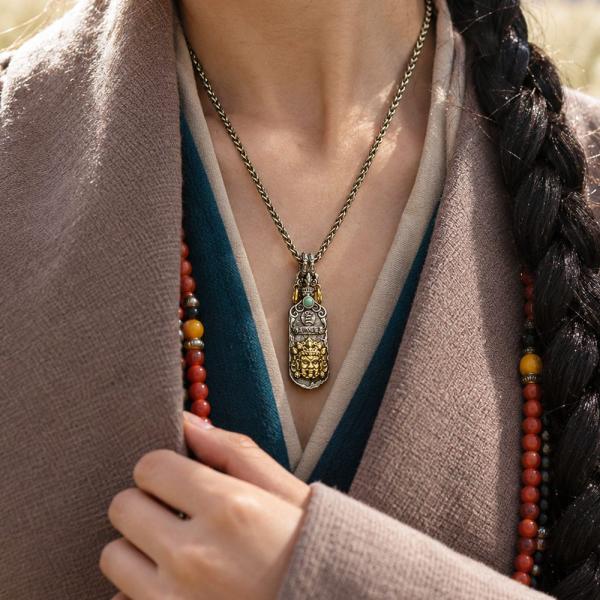
The advantage of a rectangular plaque is composition. A round one has to be cropped along the curve, and figures lose hands and feet at the rim; a rectangle has four corners that hold their ground, so jewel, mongoose and lotus base can be laid out one by one with space left at the edge. All four corners are rounded, so the piece sits against the chest without digging, and it will not press a square mark through a turtleneck. When you choose one, hold it up and check that it hangs true. The hole is usually centred on the top edge, and a millimetre off shows as a tilt, more so once a collar pushes against it. Thickness matters as well: too thick and it presses the neckline, too thin and it feels weightless.
White copper runs cool and the brass lines run warm, so a single piece carries two temperatures and holds its own against charcoal or navy. Left alone, white copper turns yellow over time, the edges and hollows darkening first. That is oxidation, not plating wearing through; it will not polish back, and it does not need to. A dry soft cloth is enough. Skip the silver cloth and its circular rub, because the abrasive in it rounds the inlay seams, and once the lines blur the pattern goes with them. A piece kept in its box dulls more slowly, but over a few years it changes just the same.
A wealth deity is the usual gift for a friend in business, though the wording should stay modest. In Tibetan teaching Yellow Jambhala is a protector first and a source of wealth second, and what older people ask of him is enough and never running out, not a sudden fortune. That measure wears better than the word prosperity. It works for an elder too, though they may not know the figure, so say who he is. A slip of paper in the box naming the subject saves a long explanation at the table. And once it is given, do not ask whether they wear it.