


Menu
By theme
By theme

{{ variable.name }} : {{ variable.values[selectedVariantsIndex[variable_index]].name }}
Quantity:
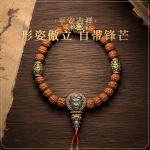
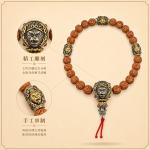
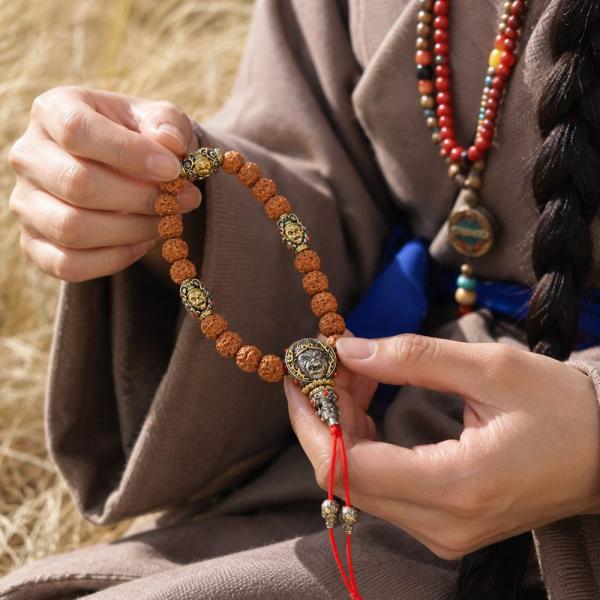
Great Sage Equal to Heaven is the title Sun Wukong gave himself. In Journey to the West he resents the small post of stable keeper, goes back to Mount Huaguo and raises that banner. The three-hole bead takes exactly this stage of him: the stage version, with a purple-gold crown, two long pheasant feathers sweeping upward, the face painted in a peach shape and a ring of gold around the eye sockets. The theatre fixed this look; the novel is not that specific, but this is the set that audiences recognise. There are two feathers, one on each side, and the longer they are the more imposing; on a piece this size they can only be shortened.
A monkey face at small scale is a question of proportion. The heart-shaped forehead has to be pressed low, the eye sockets cut deep, the mouth pushed forward, and all three sit inside a square inch. Go shallow and the face flattens into a blob; go deep and it turns into a demon. The feathers are the most fragile part, thin strips that often come short in the cast; on a good piece the tip is rounded rather than spiked, since a spike both pricks the finger and fails to fill. The fur costs labour too: individual hairs are too fussy, so the carver suggests them with a few shallow grooves.
Antiqued copper sinks in tone, the hollows going black while the high points keep a little red. A monkey face has plenty of relief, so the ageing darkens the eye sockets and the corners of the mouth by itself, and it looks more alive than bright new copper. The finish is not a coating; it is colour the copper raises on its own, and it will not rub off, nor does it need to. If you must wipe it, use a dry soft cloth and no water. The sockets are the deepest point and collect the most shadow, which is where the face comes alive.
Sun Wukong is one of the few subjects that needs no explanation. Old and young know him, and he is an easy gift. There is also no need to push him toward the gods: he is a character in a novel, not a Buddha, and a familiar story is a steadier line than a claim of efficacy. A child wearing one rarely meets parental objection, a privilege the Great Sage has to himself. For children, avoid small separate fittings; only something large enough is safe to discuss.
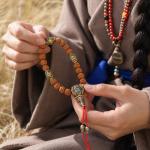
The three-hole bead is the piece that closes a strand. The set includes a stupa and disciple beads, so you string bodhi beads, branch at the three-hole bead, hang a stupa below and then a few small beads. Which way the monkey faces matters: usually the face goes outward, so others see it, and you turn the strand around when you want to look yourself. The holes must pass cleanly and the angle between the three has to be even, or the drop hangs off true. The number of disciple beads adjusts the finished length, one more or one fewer either way.