


Menu
By theme
By theme

{{ variable.name }} : {{ variable.values[selectedVariantsIndex[variable_index]].name }}
Quantity:
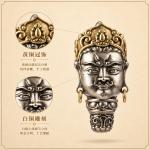
Padmasambhava is the figure who came into Tibet from India in the eighth century. The Nyingma school honours him as its founder, and in Tibet he is usually called Guru Rinpoche. His form is easy to pick out: a pointed lotus crown, a vajra in the right hand, a skull cup in the left, and a trident tucked under the left arm with three severed heads hanging from it. There is a great deal of equipment, and on a small piece only the crown, the vajra and the trident can survive; the shaft of the trident is thin and is often dropped from a pendant or merged into the halo behind him.
The lotus crown is this figure's signature. It comes in five-pointed and three-pointed versions, and the points carry eyes, which blur at small scale. In a cast crown the points only stand if the body of the crown has thickness behind them; thin the wall and the points lean. When you examine the work, check whether the points mirror each other and stand to the same height, which is how you know the mould has not drifted. Once the crown is right, the figure is recognised; vajra and skull cup can both be simplified, but the crown cannot be left out.
The pavé stones mostly fall along the rim of the crown and on the necklaces, and a few are enough. More and the surface looks broken up. Choose deep colours, red or deep blue; too bright and they steal the scene from the face. The setting should be shallow so half the stone shows and light can get in. Pressed deep, the stone is smothered in metal and looks like a grain of sand stuck there. Avoid transparent stones: they show the floor of the setting and read as empty.
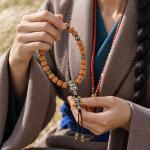
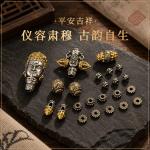
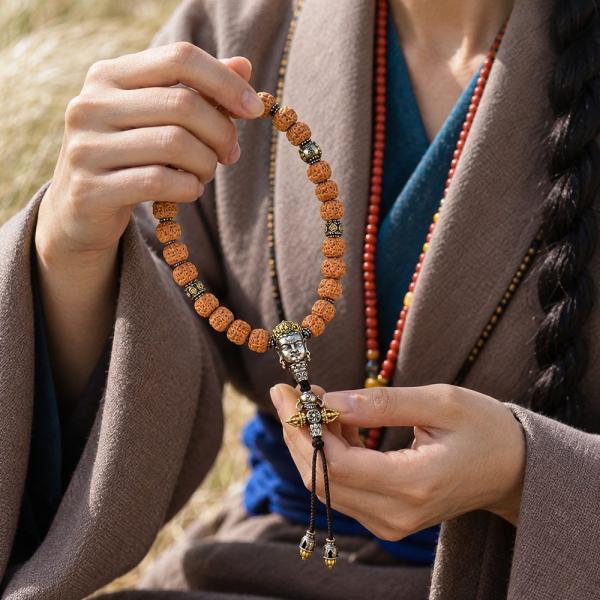
The three-hole set suits a Tibetan-style strand. Dark wood, bodhi root or old material all hold their own against the darkness of the copper; pair it with warm stones such as Southern Red or amber and you have cold against warm, which is a matter of taste. The stupa in the set is usually the same material and colour as the three-hole bead, and its tip is thin, so do not force anything when you string it; copper tips bend before anything else. A Tibetan strand wants its fittings complete: three-hole bead, stupa, spacer disc, disciple beads.
Padmasambhava carries great weight in Tibet and is less known in Han regions, so pick your recipient. When you talk about it, say it is the form of Guru Rinpoche and do not steer toward a blessing by a living lama, which is not a seller's line to use. Take it off for bathing and swimming: copper does not mind water, but water standing in the settings does. Store it with the crown points up and nothing pressing on them. In Tibet he is a founder, not a wealth deity, so do not put a request for money to this one.