


Menu
By theme
By theme






{{ variable.name }} : {{ variable.values[selectedVariantsIndex[variable_index]].name }}
Quantity:
The first job with a spacer is to measure. Whatever size the main beads are, choose a spacer slightly smaller, by a tenth or two, which looks most natural. The same size and it reads as another main bead; larger and the balance of the strand is lost. Without callipers, wrap a strip of paper round a bead and measure the length of the paper to get a rough figure. Better too few spacers than too many: add too many and the strand fragments, and three or fewer is safest. Too small and it is invisible; too large and it crowds the main beads, so err on the small side. Allow for the cord when measuring, because a thick cord needs clearance in the hole.
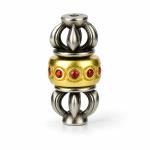
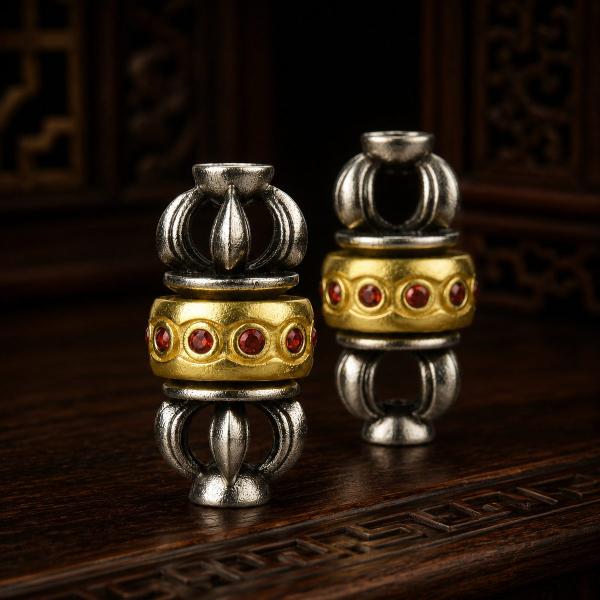
A vajra used as a spacer can only be the middle section. The ends are prongs and the centre is the grip, and a spacer has to be threaded, so the grip, being the narrowest part, is where the hole goes. How much of the prong shape survives depends on the size of the bead: a larger bead can keep the outline of three prongs, while a small one can only be single-pronged, and more than that blurs. The single prong is simplest, a straight column tapering at both ends; a three-pronged version has three grooves cut in the middle, and the depth of those grooves decides how three-dimensional it looks.
The holes in brass pieces deserve particular attention. A spacer hole is small, so a thick cord will not pass, while a large hole lets the bead slide along the cord. If the mouth has a burr, the cord will break before long, so run a fine abrasive strip round it when the bead arrives. Waxing the inside of the hole is an old trick and it works. Brass spacers are soft, so rubbing against hard main beads wears them down, and over long wear you should watch whether the hole has enlarged. Clean up a frayed mouth rather than waiting for the cord to break mid-strand.
The number of spacers follows the length of the strand. A wrist mala takes two to four, a longer strand six to eight, placed at equal intervals. A vajra has a direction, so the points should all face the same way; if they are mixed within one strand it looks scattered. In a group of two, set the points towards each other with a main bead between them. Do not put a spacer right against the three-hole bead; leave one main bead of distance, and the layering shows.
Brass spacers go best with wood and bodhi main beads, and look dull beside glossy stone. With wear the edges polish bright, which is normal for brass and needs no special treatment. Take them off for showers and sport, because sweat in the hole turns green. Paired with coloured stone such as Nanhong agate or turquoise, the brass is overpowered, so plain colours are better. Leave a little space between spacer and main bead and the strand breathes. No oil is needed day to day; a dry cloth beats any care liquid.