


Menu
By theme
By theme

{{ variable.name }} : {{ variable.values[selectedVariantsIndex[variable_index]].name }}
Quantity:
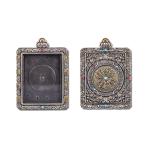
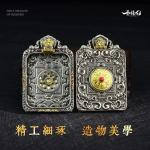
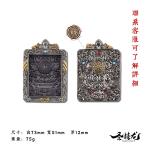
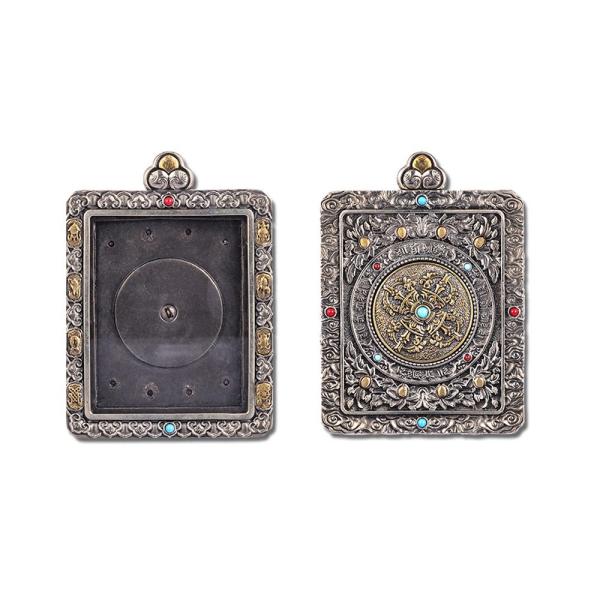
Gau is a transliteration from Tibetan, and plainly it means a small shrine box that you carry. What goes inside differs from house to house: a small image, a text, a relic, medicinal herbs, a scrap cut from a teacher's robe. It hangs at the neck and travels with you when you leave, and nomadic families value it especially, since a home can be packed up and the box goes with the person. There is usually a lid over the opening with a ring on it, and the chain passes through the ring.
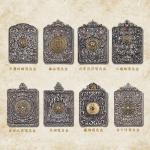
The six relief designs are six different statements. The alms bowl is the Buddha's eating vessel and stands for wanting little. The eight auspicious symbols are the parasol, the golden fish, the treasure vase, the lotus, the right-turning conch, the endless knot, the victory banner and the wheel of dharma. Flame is mostly used behind a figure, wisdom burning away affliction. The six-syllable mantra is Avalokiteshvara's heart mantra. The two deer listening come from the first turning of the wheel at the Deer Park, with the wheel between them. The eight auspicious substances are mirror, curd, durva grass, bilva fruit, right-turning conch, bezoar, vermilion and white mustard seed. Choosing a design is choosing a sentence to carry with you. The order of the eight symbols differs between traditions; people who know the material read the shapes, and people who do not enjoy the look.
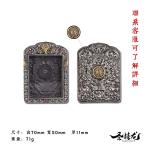
Whether a box is any good shows first in how it opens. Lid and body have to bite: too loose and it opens by itself, too tight and you cannot pry it without splitting a fingernail. Then look at the cavity and whether it is deep enough to hold anything, since a shallow one takes a slip of paper and nothing more. The relief is on the outside and the inner walls are smooth, which makes them easy to wipe and easy on the fingers. Check whether the hanging ring is cast with the body or soldered on afterwards. Cast with it is stronger; on a soldered one, look at whether the joint is full. A lid that has been opened many times will loosen, and then it can be eased by bending the rim slightly with the fingers, never with pliers.
White copper is hard enough that the walls can be made thin, so the box does not drag at the neck. The relief does not stand high; the layering comes from polished faces against shadow in the hollows, the usual method on small pieces. Raise the relief and the walls have to thicken, and the weight climbs with them. Dust settles in the hollows, especially in a winding motif like the endless knot, so brush along the pattern with a soft brush. If you keep something inside, line the box with soft cloth, because copper against paper stains the paper.
A gau box is worn close: a short chain, the box at the centre of the chest, under the clothing and against the skin. Copper takes a warm tone from sweat, which is how people wear them in Tibet. Do not stuff the inside at random. Paper slips, incense ash and photographs all get put in, and before any of it goes in, decide whether it is something you mean to carry for years. Take the box off to bathe, since water that gets inside ruins paper and cloth before anything else. As for filling and consecrating it, practice varies from person to person, and it is not a seller's business to do it for you.