


Menu
By theme
By theme



{{ variable.name }} : {{ variable.values[selectedVariantsIndex[variable_index]].name }}
Quantity:
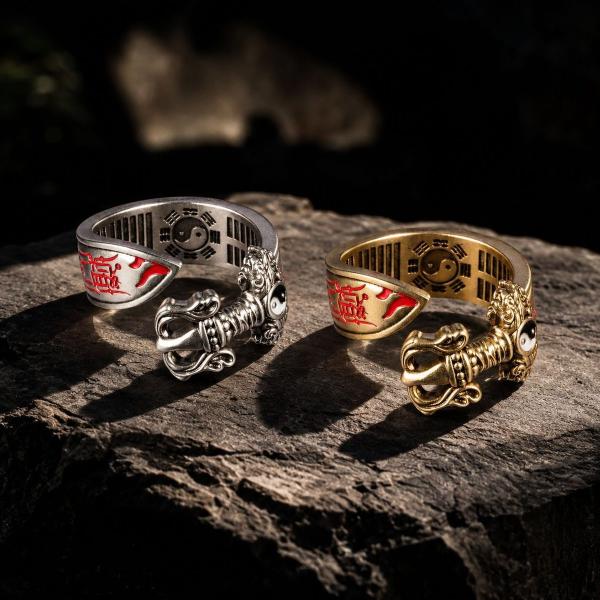
This ring puts three things together: the taiji diagram, the bagua and a vajra pattern. The first two belong to the Daoist system and the third comes from Buddhist tantra, so the combination is a mixture. Folk ornament has always mixed in this way; ordinary people do not ask which school a symbol comes from, and if it looks good and has a story behind it, they wear it. The maker is not troubled by it either. A bezel is only so wide, and whatever fits goes in. The order of work is to cast the pattern, trim the edges and polish at the end.
The arrangement of the bagua matters. In the Earlier Heaven sequence Qian lies south and Kun north; in the Later Heaven sequence Li lies south and Kan north. Both are seen, and you can tell them apart from the image: with the Qian trigram, three solid lines, in the southern position it is Earlier Heaven; with Li in the south it is Later Heaven. Most of what is on the market is Later Heaven, because feng shui compasses use that sequence and most people who recognise the diagram are people who read compasses. Either sequence works on a ring, but a particular buyer will have a preference, and asking costs nothing.
The vajra here is a pattern, not a ritual object. It takes the five-pronged form: one prong through the centre, four curving out and closing again, laid around the outer ring of the bagua and running once around it. The pattern is fine and blurs easily in the cast; on a good piece you can see the gaps between the prongs, and on a poor one it is a smear. This is the most reliable place to judge the work. The number of prongs is not worth arguing over: five is the norm, and three are also made.
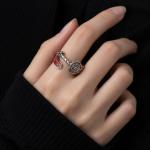
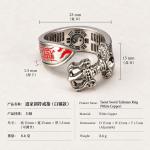
A wide bezel with a full pattern is the lead actor on the hand. A width like this does not stack well with other rings, and one is enough. Leave some allowance in the size, since a wide face is hard to get over the knuckle, and measuring the base of the finger is more accurate than measuring the joint. On short fingers, take a narrower border, because too wide a face cuts the finger short to the eye. The inner wall should be polished; the pattern belongs on the outside only, and a pattern inside rubs the finger.
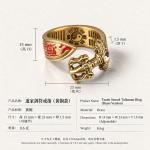
White copper reads as silver and brass reads as gold, and the same ring carries itself very differently in the two. White copper with dark clothing looks bookish; brass with cotton, linen or leather looks rough. Copper darkens, and the yao lines in the hollows go black first, which makes them clearer rather than dimmer; to keep the piece bright, use a dry soft cloth and no copper dip, since the lines are shallow and a dip flattens them. Both versions have bevelled edges, so they do not wear through a cuff over time.