


Menu
By theme
By theme



{{ variable.name }} : {{ variable.values[selectedVariantsIndex[variable_index]].name }}
Quantity:
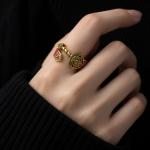
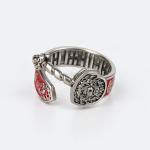
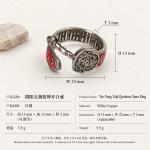
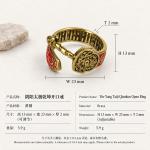
The two fish of the taiji diagram are not two semicircles drawn at random. A spot of black in the white and a spot of white in the black say that yang holds yin and yin holds yang, that both are turning, and that at the extreme each becomes the other. The figure settled late; it is generally traced to the Song, to Zhou Dunyi's Explanation of the Taiji Diagram, which joined the diagram to the line about the Ultimate of Non-being and the Great Ultimate, and after that it spread. The two dots, the black eye in the white fish and the white eye in the black, disappear if they are made too small.
The bagua runs around the outer ring: Qian, Dui, Li, Zhen, Xun, Kan, Gen and Kun, at the eight directions. There are two sequences, Earlier Heaven and Later Heaven, and rings mostly carry the later one, because compasses use it and the feng shui men recognise that version. The yao lines should be even in length and the gaps between the three lines equal; make the gaps uneven and the trigram looks scattered. Some lines are broken and some unbroken, and one stroke in the wrong place changes which trigram it is.
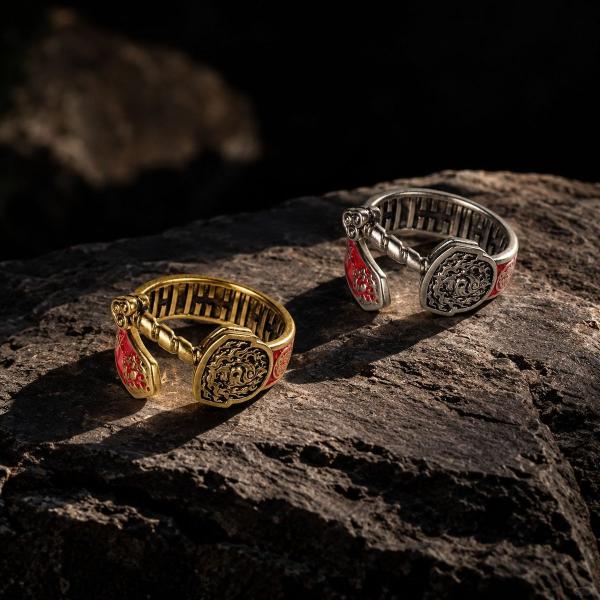
The opening is left at a seam in the bagua, with a rounded end on either side, so it does not scrape the finger when the band is bent. The size of an open ring can be adjusted, which is why the size field gives no number. A finger varies by half a size between summer and winter, and is thinner in the morning than in the afternoon, and this is exactly where the margin for adjustment earns its keep. When in doubt, leave it looser. Do not open the gap too wide, because copper springs back and a band opened too far stays loose.
Worn a long time, a copper ring polishes to a bright band on the inside while the outside dulls. That is the hand's doing, not a fault. To even it out, turn the ring on the finger every so often. Dry your hands after washing, since water pooling under the band leaves a dark line in time. Do not wear it to chop vegetables or shift furniture; copper is soft and one knock leaves a dent, and a dent across a yao line is the most conspicuous place it could land. Keep the ring in a fixed spot when it is off, because copper pieces are most often lost on a washbasin.
Set the two versions side by side and the white copper taiji separates yin from yang by light and dark, while the brass one separates them by colour, and each has its own reading. White copper is cool, and on pale skin it looks clean; brass is warm and does not conflict with skin that runs yellow. This is not a rule. Put both on your hand at the counter, which is far more reliable than looking at pictures. Under a lamp the white copper leans blue-green and the brass leans red, and you only see it with the two together.