


Menu
By theme
By theme

{{ variable.name }} : {{ variable.values[selectedVariantsIndex[variable_index]].name }}
Quantity:
The old calendars cut the days into seven and gave each one a heavenly body: sun, moon, Mercury, Venus, Mars, Jupiter, Saturn. The scheme came in from the west. Tang almanacs already used it to count days, under the old name of the seven luminaries. Japan still calls the days moon, fire, water, wood, metal, earth, sun, a habit carried over from that time. In the Book of Documents there is a line about ordering the seven governments, and commentators mostly take the seven as the sun, the moon and the five planets, though whether that was the original sense is argued. Matching a luminary to a day is calendar work. Matching it to good or ill fortune is divination. The two are separate trades.
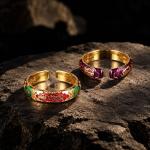
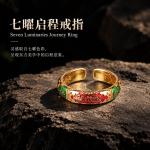
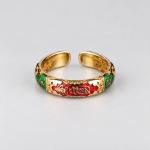
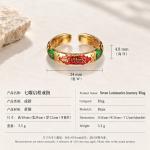
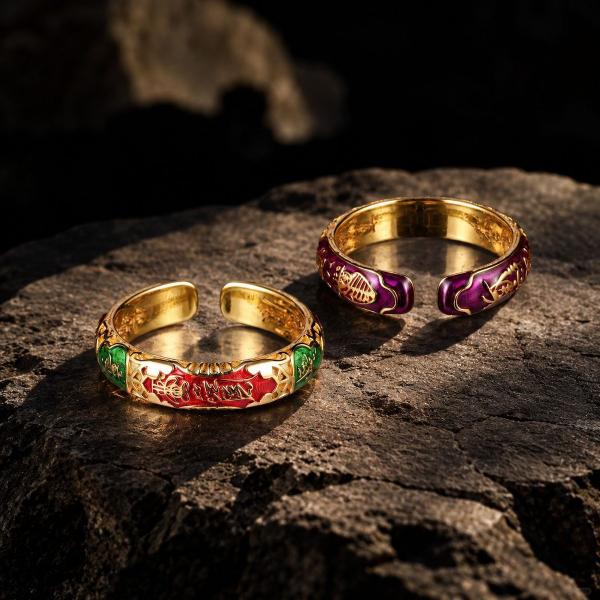
The face of this ring is cut through. Seven luminaries run around the band in fine lines, and light passes between them. Openwork is harder than a solid face: the metal underneath has to be cleared out, and the ribs left behind have to be even. Too fine a rib and the molten copper will not fill it, so it breaks; ribs of uneven thickness heat unevenly in the kiln, and the enamel cracks. Enamel goes into the small cells between ribs. The filling needle has to be fine, and one tremor puts the enamel over the line. Enamel outside its cell cannot be ground back after firing; that whole section has to be picked out and filled again. Twice on one piece and the work is spoiled.
The seven marks have no fixed drawing. What people use day to day is a circle with a dot, a crescent, a star with a tail. How many dots or strokes each carries was left to the craftsmen of each dynasty. This ring takes the plainest version, no figures of gods, only the marks, so from a distance it reads as a band of geometry. Not knowing all seven does not stop you wearing it; knowing the ring stands for seven days is enough. Some treat it as a star chart, which also holds up — only do not push it toward astrology. Set around the band, the first mark has to line up with the center of the face. Off by a little and the whole ring sits crooked.
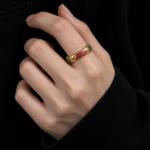
The opening is on the palm side. It does not open far; white copper has only so much spring, and forcing it leaves a pale crease. The face is wide, so it goes over the knuckle at an angle. Push it straight and it jams. Plating is thinnest on the cut edges of the openwork, and those wear faster than a flat surface; a month of wear and the outline goes white. When you write, the face knocks the desk. Change fingers and you save a good deal of that.
Openwork with enamel fears pressure above all. A key in a bag pressing once can bend a rib, and the enamel goes with it. There is no mending that. Take it off and keep it in a small pouch. Clean it with a dry cloth only, never soak it: water trapped in the cells cannot get out, and the copper underneath turns green. Hands sweat in summer, so wipe it at home before putting it away. Sweat left in the seams overnight smells by morning. The edges of the opening are not chamfered and feel a little sharp; rub them with a scrap of leather twice before you wear it.