


Menu
By theme
By theme



{{ variable.name }} : {{ variable.values[selectedVariantsIndex[variable_index]].name }}
Quantity:
Warring States tombs have yielded glass beads with concentric rings set into the body, a dark circle inside a light one, a raised point at the center, so that the bead looks back at you like an eye. Today they are called dragonfly eyes. Not all of them were made here. The early batch has a composition close to glass from West Asia and the Mediterranean; later the Chu region made its own, the shapes settled into local taste, and the eyes gained more rings. The eye pattern thinned out after the Han, when glass beads turned to single colors.
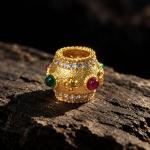
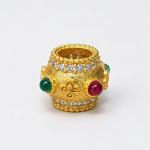
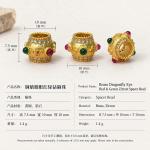
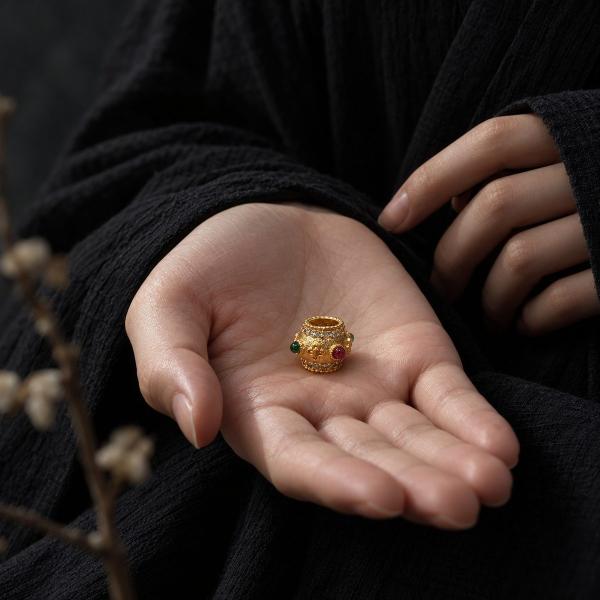
The eye is built by layering color. A layer of dark glass is wound on, then a dot of light, then a dot of dark, each one smaller than the last, and while the glass is hot it is pressed so the eye swells up. Copying it in metal takes another road. A zircon is set into a cast eye, half red and half green, and the stone’s refraction supplies the bright center. The stone is cut with a domed face and a flat back, which is the only way it sits down properly in the setting; cut it flat on top and the eye goes dead. The two stones have to be the same size. One larger than the other and the eye looks off.
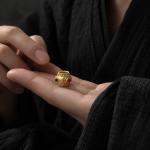
A spacer exists to hold the main beads apart. Two big beads set side by side grind against each other at the contact, and in time each loses a piece. Put a bead between them and the spacer takes the wear; replace that one bead and the matter is finished. A dragonfly eye is not large. Slid between dark wood beads or bodhi seeds, it is a small jump of color. There is no need for many: two or three in a strand will do. Fill the strand with them and eye faces eye, which reads as clutter.
A gold-plated rim wraps each eye, standing a little above the stone so the stone is not the first thing to be rubbed. Red and green together are not a refined pairing, but they are lively, and this pairing is common on Tibetan-style strands. The eyes can face any direction. Strung, they turn as the strand turns, and whichever way they come up there is an eye. The hole is drilled through the center, symmetrical from both sides, so no eccentricity shows when the bead turns. That matters more than the pattern. The claws of the rim have to be pressed at one angle, or they catch the skin.
The zircon is set in, not grown out of the copper, and a knock against something hard can loosen it. If it loosens, do not press it back yourself; press it crooked and the claws will not close again. The copper dislikes sweat. Wear a strand through the summer and the back of the spacer dulls first. Wipe with a dry cloth and do not soak it — water lodges in the seam under the rim and the copper goes green. If a stone does fall out, find one of the same size. A color difference is unavoidable, so turn the replacement toward the back. A spacer carries no weight, and one loose stone is not fatal, but it shows the moment the bead turns.