


Menu
By theme
By theme






{{ variable.name }} : {{ variable.values[selectedVariantsIndex[variable_index]].name }}
Quantity:
On a mala, the spacer discs are the least conspicuous pieces. They sit between the main beads and break the long strand into short runs, so you know where you are in the count. Tibetan strands want their fittings complete: guru bead, spacer beads, discs, disciple beads, counters, each hanging below the last, and the disc is the thinnest layer of the lot, barely felt between the fingers. Old strands used silver discs mostly, copper rarely, because silver is soft and does not wear the beads it touches.
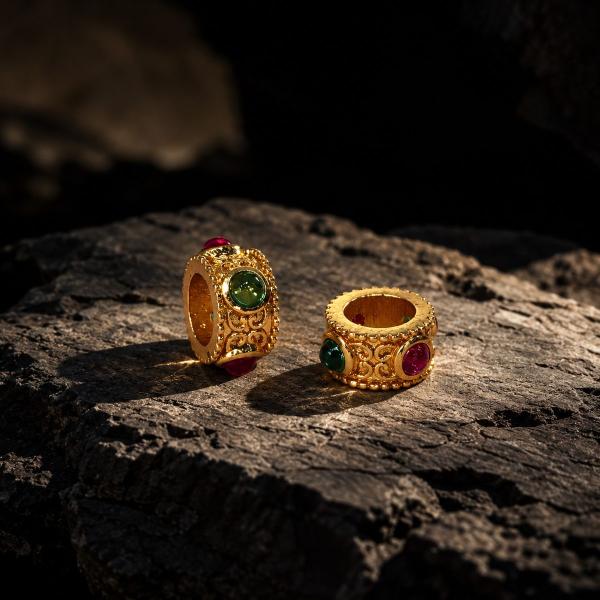
Most discs are flat rounds or small squares with a single hole through the middle, and the two faces often differ: one plain, one carved. This pair carries Tibetan patterns, a border of joined beads around the rim, red and green zircon at the center, a gold edge holding the stone faces. Thin is not the difficulty; thin without warping is. During casting the metal cools unevenly, the rim hardening while the middle is still soft, and the contraction curls the piece to one side. The beaded border is pressed one bead at a time. Press too deep and it looks like rope; too shallow and it disappears.
A cast disc warps if the thickness varies even slightly. Warped, it tilts the beads on the strand and the whole run looks wrong. So the flattening step cannot be skipped: flatten, then plate, then set the stones. A stone set deep is out of reach of wear; set shallow and a brush against something takes it out. String them four to a group, face alternating with back, and the pattern joins up. A disc flattened after warping shifts its hole by a hair, so when stringing you have to sort out which way each one faces.
Red with green is the usual Tibetan route. Coral red against turquoise was the old pairing. Zircon stands in for those two materials: brighter color, lower price. Set among dark wood beads, the red and green read as two thin edges and do not compete with the main beads. The disc is a size smaller in diameter than its neighbors, which is what gives the strand its give and take. Beads all of one size to the end of the strand are a pipe with no rhythm. A line of gold between the red and the green keeps the two colors from fighting.
The disc is thin, so all the load lands at the hole. A thick cord frays against the rim of the hole; too small a hole and doubling the cord is a struggle. When you change the cord, look at the hole for fraying, and touch it with fine sandpaper if you find any. Plating goes fastest inside the hole, where you cannot see it until the strand comes apart. A long strand uses a dozen or more discs, and one frayed hole loosens the whole run. Changing the cord, take every disc off and wipe it; that cleans them far better than wiping along the strand. The discs are small and hard to find once dropped, so spread a cloth on the table before you untie anything.