


Menu
By theme
By theme


{{ variable.name }} : {{ variable.values[selectedVariantsIndex[variable_index]].name }}
Quantity:
Shen Kuo, in the Song, copied a Tang colophon into his Dream Pool Essays. Emperor Ming had malaria. In a dream a small ghost stole his jade flute, and then a large ghost came, caught the small one and ate it. The large ghost gave his name as Zhong Kui, said he had failed the military examination and dashed his head against the palace steps. The emperor woke cured and called Wu Daozi to paint what he had seen. Scholars still argue whether the record is true; the painted type, at any rate, was fixed by it. Who painted it is a question nobody pursues now. The difficulty in a Zhong Kui picture is ferocity without malice. One degree more and you have painted a ghost.
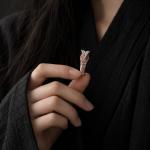
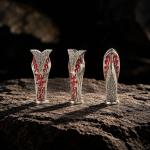
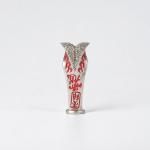
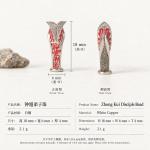
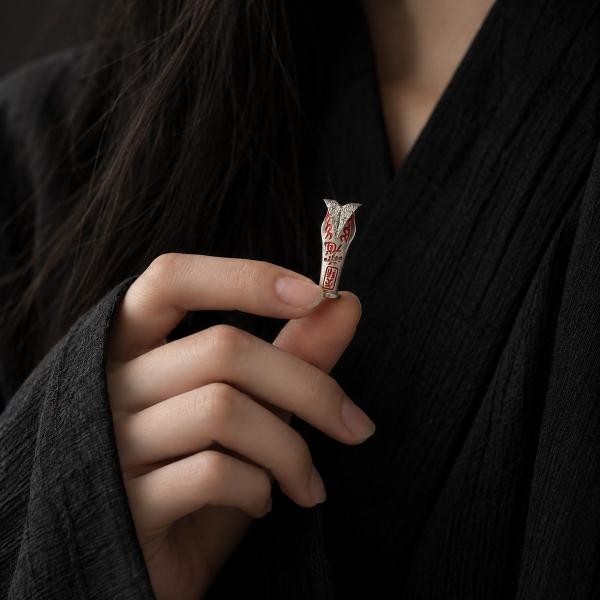
Old paintings often show him on an outing with a troop of small ghosts — one carrying a pole, one an umbrella, one a seal — crowding ahead and behind, which is why it is called the outing picture. The spacer whose name mentions disciples is probably that small figure, shrunk onto a bead until only head and shoulders remain. Zhong Kui himself is on a second bead: black face, curled beard, hat wings spread. Strung together, the two make the set. The small ghosts differ from place to place; some carry horns, some are nothing but a shadow.
Cutting a face on a round bead, the hard part is the centerline. As the face turns, brows and eyes have to follow the curve, and a slight error shows from the side as a crooked mouth. So the equator is scribed on the bead first, the nose set on that line, and the graver works outward symmetrically. The hat wings are cut last, and the two have to be the same width; a little difference reads as a tilt. The eyes are left as slits with no pupils. Add pupils and the face turns vicious. The beard goes in hair by hair, and by the third layer you have to vary the thickness or it mats.
A spacer gets handled on the strand, so every raised part is rounded off. Hat wings, beard tips, brow ridges are all blunted; the fingers find height, never a point. White copper is soft. Over time the raised faces brighten and the hollows collect a little oil from the hand, and it looks better than new: the color sinks and the face comes forward. New, it is pale and the face is flat, and it takes a season of wearing before you recognize it. The holes of the two beads must match, or one sits higher than the other on the strand.
One spacer does not do much work. Its place is the middle of a long strand, holding two main beads apart. The hole runs straight, so a thick cord passes without crowding. Do not clean it in an ultrasonic bath; shaken long enough, the thin places begin to craze. A dry cloth is enough, and no soaking, since the beard lines hold dust; a soft brush stroked along them lifts it. Leave a little space between the two beads rather than pressing face to face. White copper oxidizes from silver-white toward gray and finally settles at a warm gray.