


Menu
By theme
By theme

{{ variable.name }} : {{ variable.values[selectedVariantsIndex[variable_index]].name }}
Quantity:
Two rings nested one inside the other, able to turn, unable to come apart. The structure is old: Warring States tombs have yielded jade double rings, one large and one small, linked, cut from a single block. Carving rings from jade wastes the stone, and one wrong cut ruins the lot, which is why small double rings are common and large ones rare. Casting in copper has no such limit. The rings are made separately, nested, and the joint then closed, with the weld hidden on the inside face.
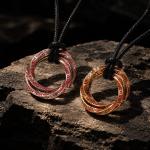
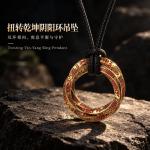
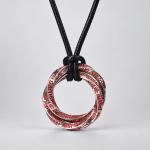
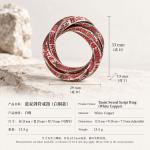
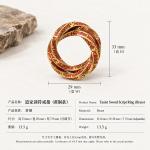
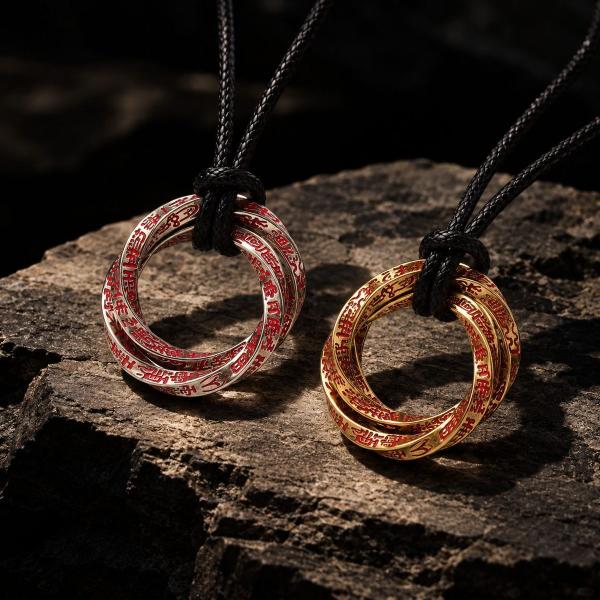
Here one ring sits within the other. The inner ring carries the bagua, the outer the taboo names, with open space between them. The antiquing leaves the hollows black and a little copper shine on the raised faces, so as the rings turn, dark and bright alternate like two circles out of register. There is clearance between the rings, neither tight nor slack; shake it and you hear a light knock. Four taboo names are cut at the quarters of the outer ring, their strokes filled black so they show as it turns. The bagua on the inner ring is cut in relief and stands slightly proud.
The phrase turning heaven and earth comes out of the Yi. Qian is heaven and Kun is earth, and to twist them is to trade their places. It is a large thing to say. Worn on a cord it is only a figure of speech: when matters are stuck, look at them from another side. A pair of rings that turns suits the idea exactly — one turn and the position has changed. Qian and Kun are the first two hexagrams, Qian three unbroken lines, Kun six broken ones, and all six line figures are there.
The bagua has an earlier and a later arrangement, and they are not the same. The earlier heaven speaks of opposites facing each other, the later heaven of sequence, and the same eight trigrams sit far apart in the two. This piece uses the later heaven: Kan north, Li south, Zhen east, Dui west, matching a compass. Anyone who knows the trigrams sees at once which system is in use; anyone who does not still finds the lines agreeable. The later-heaven directions are the reverse of a modern map, which puts north at the top; the old makers put south there. The eight names are cut outside the line figures, smaller than the figures themselves.
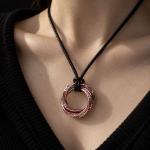
Two colors, yellow on the warm side, white on the cold. The antiquing is about the same on both, though the yellow sits deeper in shadow. Do not choose too thick a cord: a thick cord presses the rings and they stop turning, which loses the point of the piece. Copper dislikes sweat, so wipe it after a summer day. The rings do turn, and the joint loosens over the years; when it rattles, fold a cloth over it and press gently. The aged black is chemically dyed and alcohol will take it off, so keep scent away from it. The yellow on white copper is plated and will fade in time; faded, it looks more like an old piece, not less.