


Menu
By theme
By theme

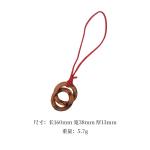
{{ variable.name }} : {{ variable.values[selectedVariantsIndex[variable_index]].name }}
Quantity:
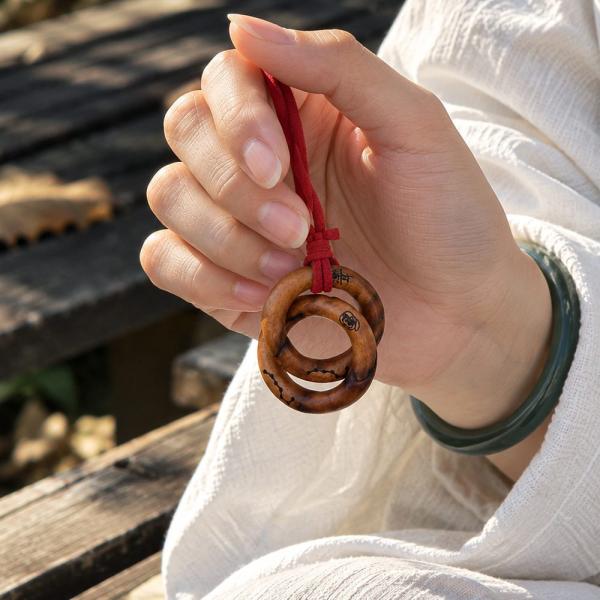
Most people first hear the words qiankun ring from Nezha. In the Investiture of the Gods he carries two treasures from childhood, the sky-mixing silk and the qiankun ring. The novel is lively; the ring itself is a simple form, one closed hoop with no joint. The more divine the book, the plainer the object, which is common enough. The silk is cloth and the ring is gold, one soft and one hard, a careful pairing on the novelist’s part. In the book the ring grows and shrinks at will; the real one comes in a single size, and if it does not fit, it does not fit.
A ring is a shape with no endpoint. Among jades, the huan, the jue and the yuan are told apart by the gap: a whole hoop is a huan, one with a notch is a jue. The ring takes its meaning from circulation and return, and the ring given in a marriage carries the same sense. Press Qian and Kun onto it and you have heaven and earth, and yin and yang as well. One circle holds both. The ancients wore a jue to mark a decision, and the line between a huan and a jue is simply whether the circle is broken.
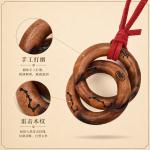
A wooden ring is harder to make than a metal one. The block is hollowed out, and the fibers curve: hard where they run with the shape, brittle where they cross it, and a good number split halfway through. The finished ring has to be even in the wall. Thin at one point and it will crack there in time. The hollowing knife has to be thin; a little thicker and it bites the wood, a little thinner and it chatters. The inner wall is rounded, because a squared ring grinds the bone of the wrist. Cut with the grain, since a single stroke against it tears the fibers open.
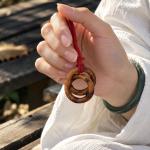
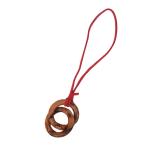
There are two ways to wear it: on the wrist as a bangle, or hung on a bag or behind a door. Wood is light and does not clack against the wrist. It shrinks a little in winter and swells a little in summer; when it is tight, do not force it over the hand but work a little hand oil around it and turn. For a bangle, take a size up. Wood does not absorb water, and sweat makes it drag. Hanging it behind a door is the old way, where the ring knocks against the panel and can be heard at night.
The color of jujube changes. New, it runs yellow; with light and handling it turns red, and after two years it is deep brown. None of that can be hurried, and oil and stain are false. Cracking is ordinary in wood. A hairline crack does not affect use; once a crack is wide enough to take a fingernail, the ring should be put away. Store it flat, because hanging deforms it. Sweat collects where the ends of the ring meet, so wipe there with particular care. Past a certain depth the color stops moving, and only then is the piece settled.