


Menu
By theme
By theme



{{ variable.name }} : {{ variable.values[selectedVariantsIndex[variable_index]].name }}
Quantity:
The six-syllable mantra is not only a thing on paper in Tibet. It is cut into stone, cut over doorways, sealed inside prayer wheels, and often set beside the guru bead of a mala. The six are om, ma, ni, pad, me, hum, transliterations of Sanskrit sounds. Chinese characters record the sound and not the meaning, so the six together do not make a sentence. What is recited is the sound, not the sense, a point that is often turned around. In Tibet the six syllables are Guanyin’s heart mantra. Read straight through, the sound breaks: one syllable at a time, sent out.
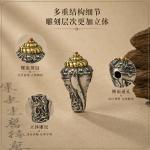
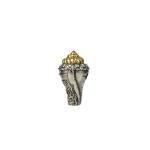
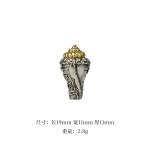
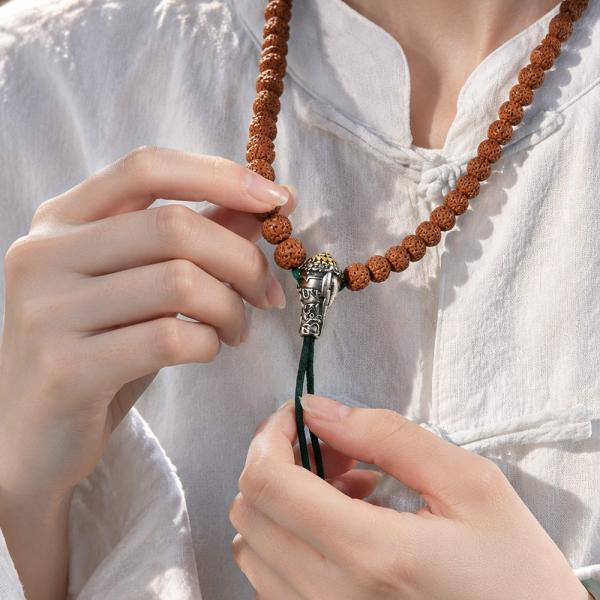
The conch is one of the eight auspicious symbols, and the white conch that turns to the right is the most valued. The horn blown in a temple is this same shell, low in pitch and carrying a long way. Made into a guru bead, the mouth of the conch faces down, the body lies sideways, the cord passes in at one end and out at the other, and the guru position falls on the back of the shell. The spire is the finest part and the first to break. Most conch spirals turn to the left and few to the right, which is why the right-turning shell is prized.
The three-hole bead marks a division in the strand: the main beads above it, the disciple beads and counters below. It is a size larger than the rest, with three holes meeting at one point, which is where the name comes from. The angle where the holes meet has to be rounded, because a right angle bites through the cord. Its hole is a size larger than the main beads’, since the cord doubles into one strand here. The third hole comes out at the side, and the tassel hangs from it. The inside of the bores is polished: rough walls wear the cord, and too smooth a wall will not hold it.
Casting a conch in white copper, the spiral has to tighten ring by ring. Tighten too fast and it looks like a spring; too slowly and it stops reading as a shell. The six syllables are cut on the side of the body, the characters small, one stroke at a time, then filled dark. Turn it over and the other side is plain. The inside of the mouth is cleaned out as well, because casting sand left there will wear the cord. The mold comes in two halves, and the rim of the mouth is finished by hand — out of round, it will not sound.
The three-hole bead takes the most strain of anything on the strand, because the cord turns a corner inside it. Do not use too thick a cord: packed into the hole, it wears quickly at the angle. Twice a year, draw the cord out and look at it; if it has frayed, replace it rather than waiting for it to part. The spire hangs downward and takes the edge of a table first, so hold the body when you put the piece away, not the tip. White copper is heavier than wood, and set mid-strand it pulls the balance down. When restringing, the bead does not have to come off; draw the cord out and thread it back through.