


Menu
By theme
By theme


{{ variable.name }} : {{ variable.values[selectedVariantsIndex[variable_index]].name }}
Quantity:
In the Han, the qilin was painted on bricks. In Han reliefs it has a deer’s body, a single horn, a bushy tail and sometimes wings. That qilin is a long way from the later one. The Ming and Qing fixed the type as dragon head, deer body, ox tail, horse hooves, with scales over the whole body. One beast’s face, altered across two thousand years. Altered to the present, people recognize only the version in front of them. The Han had never seen a real qilin; what they drew was an assembled auspicious beast.
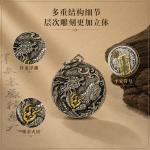
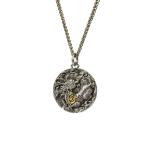
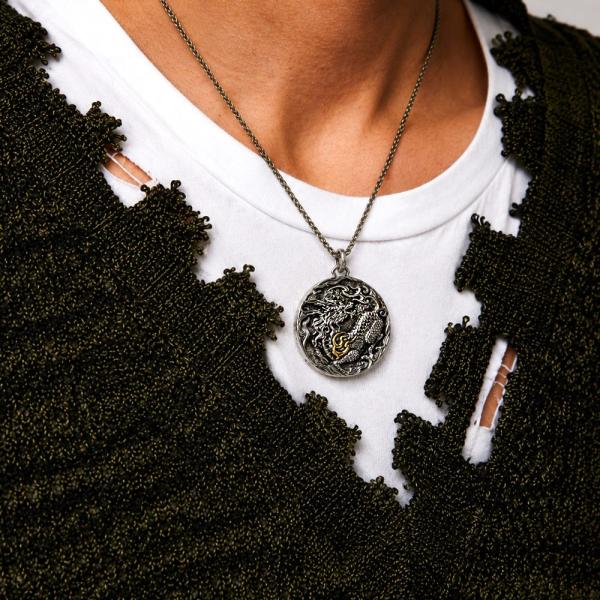
On this round plaque the qilin fills the face, its four hooves planted on fire patterns. The fire pattern is flame abstracted, curling up in tufts with the points turned outward, a filler common on Ming and Qing brocade and porcelain. Qilin paired with fire comes out of the term fire qilin, and folk New Year prints draw it the same way. The fire sits only along the lower edge and at two corners, not over the whole field; spread everywhere it would compete with the beast. The curls turn inward and the tails outward, all in one direction. Flame tips have to be sharp; blunted, they read as water ripples. The fire is not colored. Its layers come from the height of the copper.
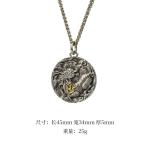
The plaque bulges slightly at the center and carries a narrow ridge at the rim. The qilin’s head faces left, the body curled into a half circle, the tail sweeping up from the lower right to fill the empty ground. The relief runs in two layers, the beast and the fire, with the fire beneath and a line lower. The hole sits at the center of the back, a little above the middle, so the plaque does not turn over on the cord. The scales are cut with a slanting graver, one laid over the next in the same direction, so the light runs smoothly across them. The hooves are cut with three toes and no claws, which is what separates a qilin from a lion. The ridge at the rim is very narrow, and once it is polished round the boundary is gone.
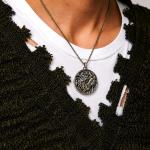
It comes as a pendant alone and as a pendant on a chain. The chain is a flat-link type, the links pressed thin, hanging without twisting; without a chain you fit your own cord. The plaque has weight, so it does not float on the chest, and it taps lightly when you run. The chain reaches the chest, which sits right at a shirt collar; longer and the plaque sinks into the cloth. The clasp is a spring clasp and can be fastened with one hand.
Horn, hooves and tail tip are the three places that take a knock, so do not leave the piece lying about when you take it off. White copper dulls, and dulled it actually shows the relief better, so there is no need to polish it bright in a hurry. If you do polish, press a silver cloth on the raised faces and leave the dark in the hollows. The fire tips are the finest cutting on the piece, so keep a toothbrush away from them; stiff bristles catch and bend. In summer, with more sweat, the back spots first, and the back is easy to miss when wiping. Store it flat, face up, and do not let the horn be the first thing to touch the surface.