


Menu
By theme
By theme




{{ variable.name }} : {{ variable.values[selectedVariantsIndex[variable_index]].name }}
Quantity:
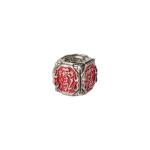
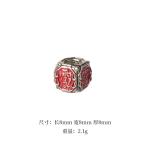
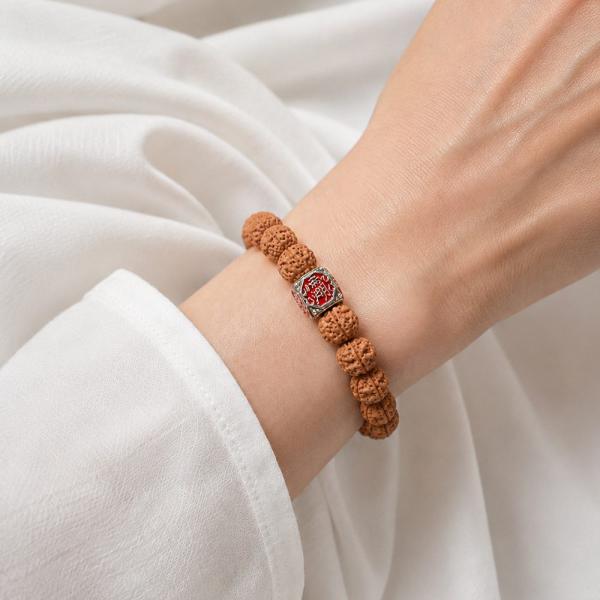
A hexagonal spacer finds its own position on the strand. A round bead turns wherever it likes; a hex bead stops as soon as two of its faces lie against the neighboring beads, and then the bagua directions are settled. Someone thought about this small point. Once the directions are fixed the strand has a front, and you do not have to turn it every time you put it on. There is a second advantage: on a table it does not roll, and dropped it comes to rest. Six faces carry six trigrams, and the two left over are given to the taboo names, which is spare capacity rather than waste.
Six sides answer to the six directions and to the six lines. A hexagram is six lines counted from the bottom, each position with its own name. The bead has six sides, one trigram to a side; that accounts for six of the eight, and the top and the bottom take the taboo names of the Three Pure Ones, which fills the set. The order of the six faces cannot be scrambled, or the trigrams shift out of place. When the master is made, the six faces are numbered and checked again after cutting. The six directions — above, below, front, back, left, right — are not the same set as the bagua directions, and the two should not be spoken of as one.
The Three Pure Ones are Yuqing, Shangqing and Taiqing, the three highest figures in Daoism. Their taboo names are written against normal character form, strokes stacked on strokes, unpronounceable. Cut on a spacer, the characters are the size of a grain of rice and the graver tip does the line, with not one stroke allowed to break. After cutting, turn the bead and check each face for even depth. The strokes are filled black; black against white is the only way a character that size can be seen. The names are not ordinarily written out in full, and are not read aloud when they are written. That is the old rule.
Casting a hexagon in white copper, the flatness of the six faces is the hard part. One face high and one low and the bead sits crooked on the strand. After casting it is lapped on a flat plate until all six faces will stand. The hole passes through the center with the edges chamfered so the cord is not cut. The six edges want a slight chamfer of their own; left sharp, they chew the hole edges of the beads on either side. A hexagon wastes more material than a round bead, and the offcuts go back to the furnace.
On the strand the neighbors rub against the spacer, and its six edges brighten first. That is normal and needs no attention. Do not soak it when washing: water lodges in the seams of a hexagon and the copper underneath goes green. Wipe with a dry cloth and let it air for a while before putting it away. One hexagonal spacer can hold the orientation of a whole strand, which a round bead cannot do. The rim of the hole is where wear begins, so look at it whenever the strand comes apart.