


Menu
By theme
By theme

{{ variable.name }} : {{ variable.values[selectedVariantsIndex[variable_index]].name }}
Quantity:
The two characters chi ling were never meant for ordinary people. Chi is an order that runs from above downward, the word an imperial edict opened with, and Daoism borrowed it: chi ling written on a talisman means that the talisman carries an order handed down from above. Written as large as you like, it is still only a written form, not a real document. A written form has its own rules. Strokes cannot be added at will, because one extra stroke makes a different character. On a talisman the two are usually set side by side, sometimes written out as a line of small characters.
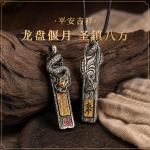
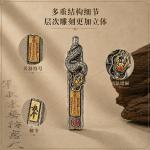
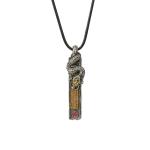
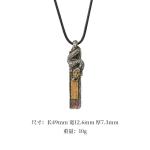
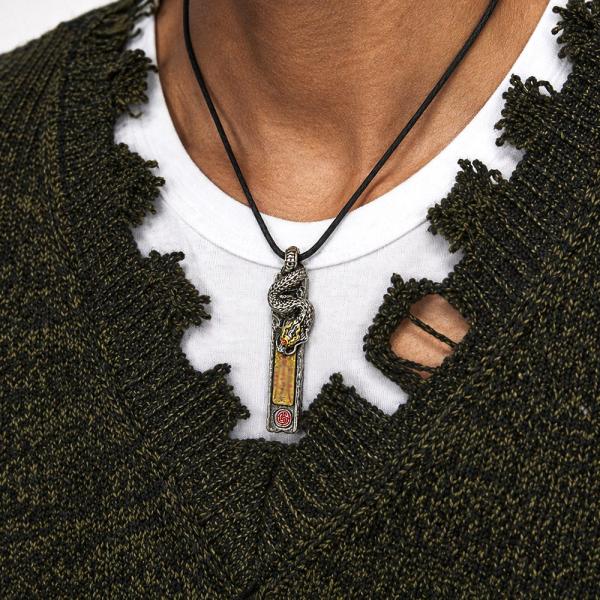
The long plaque stands upright, chi ling at the top and a dragon coiled below. The body winds in an S, head at the lower left, tail at the upper right, the scales laid in diagonal rows. The plaque is narrow in proportion, so the picture can only run vertically; a dragon stretched across would fill it at once, which is why the dragons on these pieces are coiled. A coiled dragon is harder than a walking one: once the body folds, the front and back have to be made clear. The mane falls backward, cut in layer over layer. The front claws are set low and the rear claws high, with the middle of the body pressing down on the tail. A line of dots runs along the spine as the centerline of the scales.
Dragons appear on bronzes very early. The kui dragon of the Shang and Zhou is a one-legged profile; Han dragons are slender; Ming and Qing dragons have square heads, broad noses and five claws. This piece follows the Ming and Qing line, with the claws closed rather than spread. Spread claws are the official manner, and closed claws suit a personal ornament better. The horns are like deer antlers, forked and tilted back. Two whiskers lie along the face of the plaque instead of standing out from it. There are no clouds on the copper; the blank ground is the cloud.
The back is plain with a single hole at the center, its edges chamfered. The relief on the front is low and depends on polished faces catching the light. The white copper ground runs cold, and the slanting cuts of the scales come up bright patch by patch; turn the piece and the scales go dark. Chi ling sits at the top in thick strokes, set against the fine lines of the dragon so the two read as separate layers. The characters are incised and the dragon is in relief, one sunken and one raised, which the light separates.
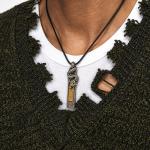
Worn on the chest, the long plaque swings left and right as you walk, though not far. Do not make the chain too long; down to the stomach is best, and past that it begins to knock. Copper fears a fall, and the horns stand out furthest. Wipe along the line of the dragon’s body rather than across the scales. The plaque is thin, so do not carry it in a pocket with keys. The strokes of chi ling are cut deeper than the scales and you can feel the step under a finger. Once the white copper dulls, the two characters actually come out clearer, and as the surface settles the incised lines deepen on their own.