


Menu
By theme
By theme


{{ variable.name }} : {{ variable.values[selectedVariantsIndex[variable_index]].name }}
Quantity:
The names of the seven northern stars are harder to pronounce one after another: Tianshu, Tianxuan, Tianji, Tianquan, Yuheng, Kaiyang, Yaoguang. The first four make the bowl and the last three the handle. The old observers read the season from the direction of the handle, and the Heguanzi says that when the handle points east, all under heaven is in spring. One turn a year, and as the direction shifts the solar terms shift with it. The observation is very old, old enough that nobody can say who made it first. Beside Kaiyang there is a small companion star, which the old people used to test the eyesight.
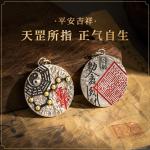
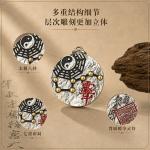
The pendant sets the seven stars above the taiji: the four of the bowl in a square, the three of the handle curving away toward one side of the bagua. The taiji sits below and takes up a third. The lines that join star to star are very fine: cut shallow they vanish, cut deep they look like cracks. The star dots are sunk half a cut deeper than the lines so they jump out in the light. Yaoguang is the one nearest the edge, and room has to be left for it or it runs off the field. The two fish of the taiji are drawn afterward, and on the plaque their eyes are only two dots.
The Dipper stands high in Daoism. It governs life and death, and the pacing of the guideline step follows the positions of the seven stars. The ritual manuals carry diagrams of that gait, one step to a star, and a wrong step throws the whole altar out. These are matters of practice, and wearing the piece does not oblige you to perform them. In folk use the seven-star plaque carries a second meaning: it shows the way. People walking at night carried one so as to have something bright in the mind.
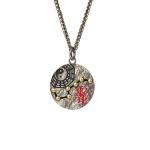
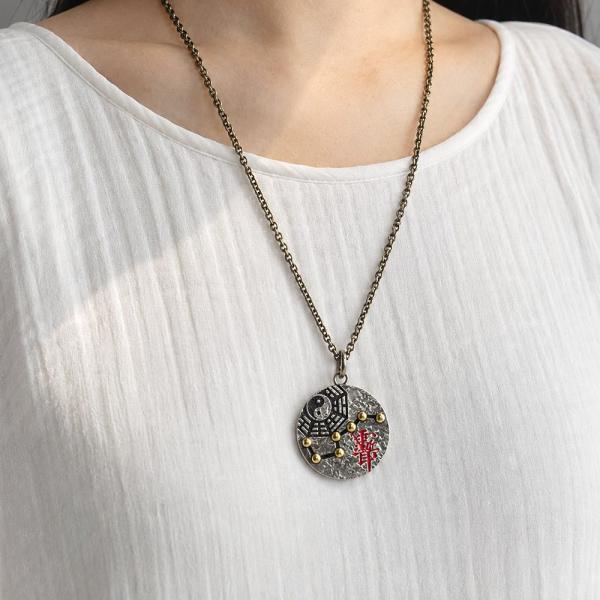
Both the pendant alone and the version on a chain find buyers. The chain is a flat-link type with pressed links that will not twist. The plaque is round, domed slightly on the face, ridged at the rim, flat at the back, with the hole at the upper edge set back a little so the face turns outward of itself. The diameter is small and it sits below the collarbone, out of sight under a round neckline. The ring of the taiji is incised, which is the reverse of the raised star dots: one yin and one yang, and the difference between them is slight. The hole on the pendant alone is a shade larger, so a thick cord will still pass.
White copper dulls with sweat, and the lines between the stars are the shallowest cutting on the piece, so once it dulls they are nearly invisible. Do not use toothpaste; the abrasive flattens the shallow lines for good. If it must be cleaned, press it with a dry cloth and leave the dark in the hollows where it is. The positions of the seven are fixed and one look is enough to learn them. The plaque is small enough that sleeping in it will press against you, so take it off at night. The dome of the face is very shallow, hardly visible from the side and only just findable by touch. Once the white copper goes dark, the star dots brighten by contrast.