


Menu
By theme
By theme


{{ variable.name }} : {{ variable.values[selectedVariantsIndex[variable_index]].name }}
Quantity:
The vajra began as a weapon. In Indian myth it is what Indra holds: copper, a blade at either end and a grip in the middle. Buddhism borrowed the shape and turned the meaning toward indestructible, which is where the word itself comes from. In Tibetan Buddhism the vajra and the bell form a pair, one yang and one yin, used together in ritual. The vajra is method and the bell is wisdom, and neither stands without the other. Once the form came into China it was made here too, at a much smaller size.
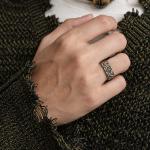
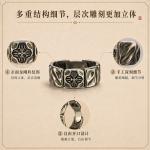
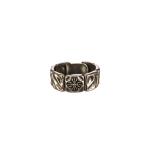
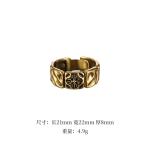
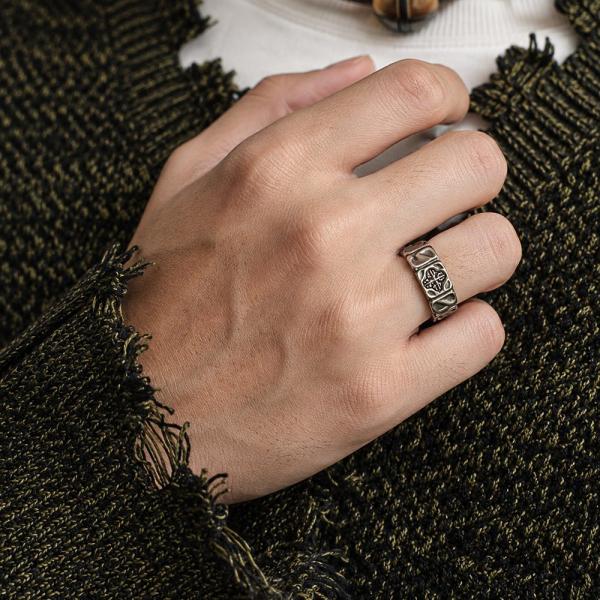
The ring bends the body of the vajra into a hoop, with the two ends drawn in at either side of the face and the middle section keeping the shape of the grip. The number of prongs carries meaning: one, three, five or nine, each with its own account. This one is three. The center prong runs straight and the two side prongs curve in to meet it. The gaps between the prongs are wider than the prongs themselves, so light gets in and the roundness of each one shows. In a three-prong vajra the center is the keel and the two sides are the guards. The prongs are round with a hint of an edge, enough that the finger does not slide.
Worn on the hand, the blades have to be blunted. A real vajra keeps its edge; made into a ring, the edge is rounded until the finger finds only a rise and fall. That is the difference between an ornament and a ritual tool: the form is kept and the use is changed. Done well, it still reads as a vajra from a distance, and close up there is nowhere it can cut you. Blunting is not flattening; the edge line stays, only the angle opens wider. The face is wide, so on a short finger it will press against its neighbor.
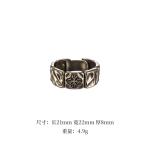
The gold and silver versions differ in surface finish. The gold runs warm, with the crowns of the prongs polished bright; the silver runs cold, the hollows left dark, so the turns of the prongs are clearer. The band is closed, which means a size has to be given and the ring cannot be pried open. A closed band is stronger than an open one, but it has to pass over the knuckle, so err on the large side. Anyone used to open rings will find a closed one tight the first time, which is normal. On the gold version the plating thins first along the edges of the prongs.
Measure the finger in the evening, when it is a little thicker than in the morning. The inside of a copper ring polishes bright with wear, which is normal. Washing your hands need not mean taking it off, only drying it afterward; take it off for a bath, since hot water and soap dull the copper. The tips of the vajra sit at the two sides of the face, so wear them toward the back of the hand and not the palm, and your grip will not press on them. The face is wide, and it sits more steadily on the middle finger than the ring finger. Resizing a closed band means going back into the fire, and every resizing costs.