


Menu
By theme
By theme

{{ variable.name }} : {{ variable.values[selectedVariantsIndex[variable_index]].name }}
Quantity:
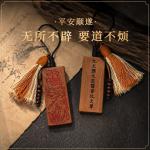
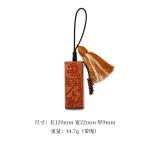
The name on this plaque, as printed on the supplier’s invoice, is “Nine Sons Mantra.” What the market usually calls it is the “Nine Syllables” — nine characters: lin, bing, dou, zhe, jie, zhen, lie, qian, xing. They come from Ge Hong’s Baopuzi, the inner chapters, in the section on climbing and crossing. That section is about what to avoid and what to carry when you go into the mountains; the nine syllables are a secret invocation of the Six Jia recited on entering the hills, and had nothing to do with wearing anything. Only later did someone cut them into a plaque. One character apart, and I won’t paper over it for a supplier. Before you buy, look at which version is carved on the face.
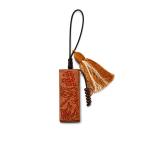
A plaque made as a fitting is not the same thing as a pendant. It comes without a chain, the hole is drilled at the top, and you string it yourself at home — waxed cord, leather cord, or a brass ring. Bead-bracelet people hang it below the guru bead as a side drop, where it swings with every step. The hole wants a chamfer, or the cord frays where it turns inside; too small and a doubled cord won’t pass, too large and the plaque hangs crooked. Don’t pick a thick one for a side drop — a heavy plaque lies on the strand and drags the whole run of cord off to one side.
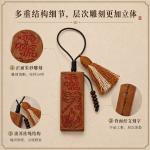
White copper is an alloy of copper and nickel, silver-white in tone and harder than pure copper, so fine strokes cut into it don’t chip at the edge. Most of the characters on the face are pressed from a die, and the depth varies: a deep cut catches your thumb, a shallow one reads at a distance as a grey line. Over time sweat and grime pack into the grooves; a dry old toothbrush takes it out in two passes. Don’t go at it with toothpaste — the patch goes cloudy. White copper brightens slowly, not like brass that flashes after a rub, and hurrying it is how you scratch it.
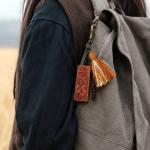
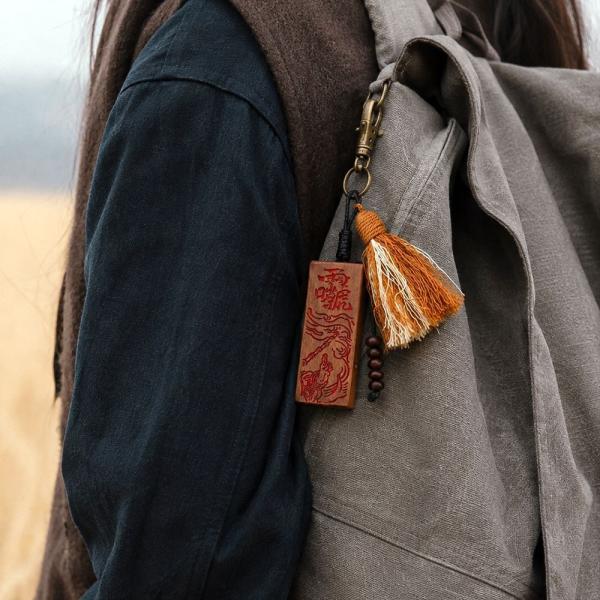
Where you hang it matters more than what is carved on it, if it is going to last. On a bag is safest — a zipper pull or a D-ring both work. On a keyring it knocks against the keys, and the characters wear first. Some people want it on the rear-view mirror, and I have to talk them out of it: the plaque has weight, it swings under hard braking, and it blocks the view. Choose waxed cord; it holds up to sweat better than cotton. Tie a double overhand knot and singe the cut end with a lighter. If you go with leather, pick vegetable-tanned — it darkens with sweat, the exact opposite of white copper’s cold tone, and the pairing doesn’t go flat.
Mantra plaques of this kind are mostly treated in folk custom as written ornament; selling one as a talisman goes too far. For a friend who climbs and is always out in the hills, “an old thing people said going into the mountains” is a more decent line than any claim about efficacy. Put a slip of paper in the box with the source written on it — whoever receives it will look it up themselves, and that works better than ten minutes of me talking across the counter. When I buy stock I take the batch with deep cuts; the shallow ones wear flat in two years and feel as if nothing was ever carved there.