


Menu
By theme
By theme


{{ variable.name }} : {{ variable.values[selectedVariantsIndex[variable_index]].name }}
Quantity:
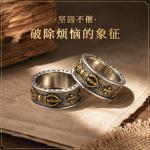
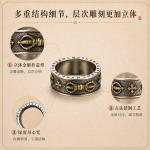
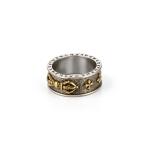
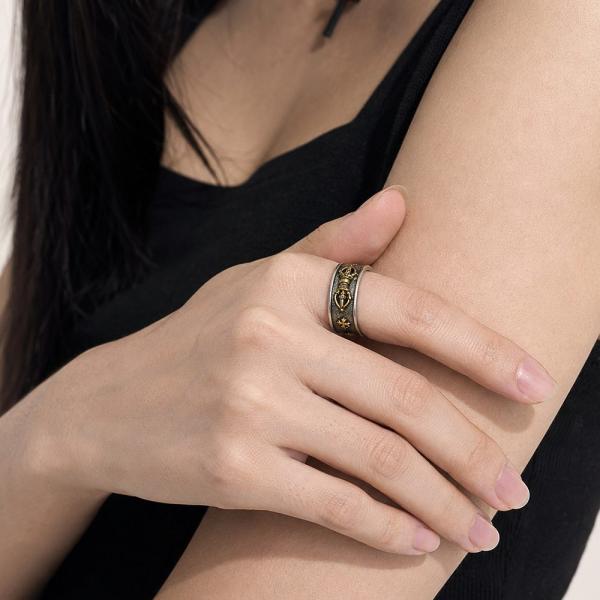
The vajra began as a weapon in ancient India and entered tantric Buddhism as a ritual implement. Its sense is indestructibility — the thing that cuts through affliction. The prongs close at both ends and the middle narrows to a waist, so it sits in the hand as a single grip. Counts run from one prong to three, five and nine, each with its own explanation; on a ring the five-prong is commonest, because any more prongs at that size blur into one mass. The gaps between prongs have to be kept open — fill them in and you are left with a copper rod.
Manjushri stands for wisdom in Chinese Buddhism; his images carry a sword and ride a lion — the sword cuts affliction, the lion’s roar breaks delusion. His heart mantra is usually written in Chinese transcription as om, ara, pa, tsa, na, dhi, the characters varying by edition while the sound stays much the same. Carving a mantra on a ring means wrapping it around the face, and when it will not fit you take only a few syllables; that is a limit of the craft and cannot be waved away. A good hand can spiral the mantra so the characters still read. A poor one leaves a ring of pattern.
White copper is hard enough that the thin prongs don’t bend easily, but the base of each prong is the weak point — that is where the stress collects, and a knock can tilt it. In summer, with sweat, the inside of the band goes dull. That is not the plating wearing through; the salt in sweat oxidizes the surface. Wipe it dry, leave it overnight, and it brightens again. Don’t wear it in the shower: soap stays in the crevices and darkens them over time. After long wear the inner wall can cloud over; it won’t wipe off, and don’t reach for sandpaper — one pass leaves a scratch.
Set upright on the face with the prong tips pointing outward, the vajra won’t catch on clothing; the horizontal layout exists too, steadier to the eye but making the face wider. The inside of the band has to be polished through — leave it with grit and it grinds the finger, and by evening there is a red ring at the base. High relief catches on cuffs and knitwear, worth weighing if you wear heavy clothes in winter. On a narrow face the relief has to be built up instead, and past a certain height two rings on neighbouring fingers push against each other.
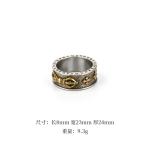
Most people who buy this are choosing it for a child who is studying, or wearing it themselves through exams and a thesis. Manjushri stands for wisdom — that much can be said, but don’t carry it further and promise that wearing it gets anyone admitted; that is a lie. I would rather put it as something to settle the mind, a thing to touch before you walk into the exam room, a reminder. Fixed-size bands need a finger measurement, taken around the base of the finger without pulling tight. Mothers buy it for themselves too, they tell me, while a child sits exams — to wear it for a while first, for peace of mind.