


Menu
By theme
By theme



{{ variable.name }} : {{ variable.values[selectedVariantsIndex[variable_index]].name }}
Quantity:
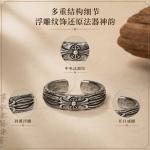
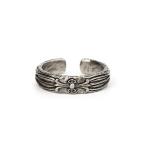
A vajra began as an implement you held in your hand. Shrunk to the face of a ring, all it can keep is the outline. This one sets the vajra dead centre and adds wings to either side, the feathers built up in relief with the depths pulled apart, so that in slanting light you can follow the direction of each tip. A vajra and a pair of wings were never one design; ornaments have long pressed them together, wanting a small piece that still carries weight. The face is crowded as a result, with little empty space. If you like clean, open surfaces, this will feel tight.
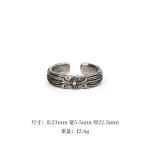
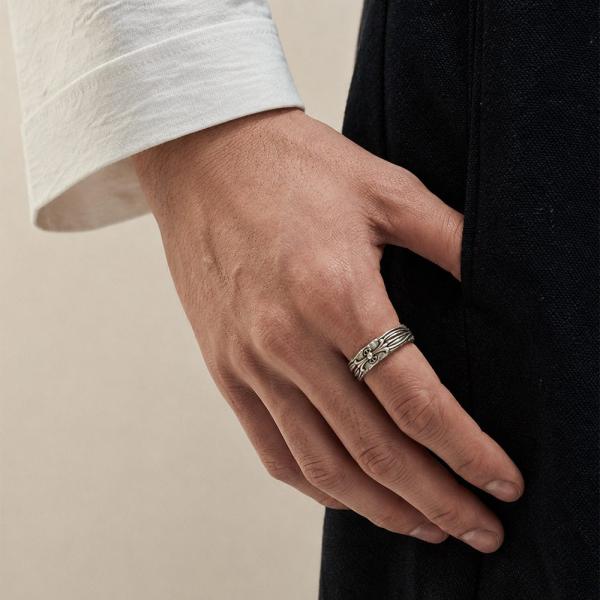
Relief sits thicker than a polished face, and you can feel the height across the back of the finger, a slight pressure when the hand closes. The band is open rather than closed: a gap at each end, wide enough to pass a knuckle when eased apart, closing again with a squeeze. Keep your grip off the pattern and press on the plain sides. The feather tips take the most force and will flatten if you bend there. On the little finger it looks clumsy; middle or index suits it better. For thick knuckles an open band saves trouble over a fixed ring, at the cost of a looser fit that needs closing again after a while.
In tantric teaching the vajra stands for what is hard and sharp, the thing that cuts through affliction. That is doctrine; on an ornament it is only a motif. Han temple images of Weituo hold a vajra in the hand, and the vajra forms in Dunhuang murals differ from those transmitted in Tibet. The shape was never standardized. Old pieces were made short and thick so they would not get in the way when carried. This one is scaled to a ring, so lotus petals and prongs can only be suggested. Judge it by the standard of a ritual implement and you will be disappointed.
White copper (cupronickel) runs cool in tone; it does not warm in the hand the way brass does at once. It is harder than pure copper, so fine lines hold and relief edges do not rub round. The trade-off is brittleness. Do not take pliers to the two ends of the opening, because repeated wide bending will start hairline cracks. It contains nickel. If your skin is sensitive, wear it half a day first, and if the base of the finger reddens or itches, move it to another finger or brush a thin coat of clear nail polish inside to block contact. Keep the polish off the outside, where a scuffed coat shows worse than a darkened alloy.
Dust collecting in hollows is the standing complaint with relief work, and the crevices between the feathers are the worst of it. Brush dry with a soft toothbrush, working along the feather lines; scrubbing across will wear the tips flat, and a thinned edge raises burrs. Take it off for showers and rough work, since one knock dulls an edge for good. Store it in a pouch rather than loose in a pocket with keys and coins. In sweaty weather, wipe it with a dry cloth before it goes back in the bag.