


Menu
By theme
By theme

{{ variable.name }} : {{ variable.values[selectedVariantsIndex[variable_index]].name }}
Quantity:
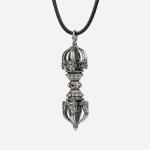
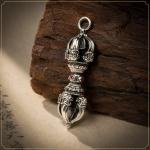
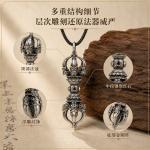
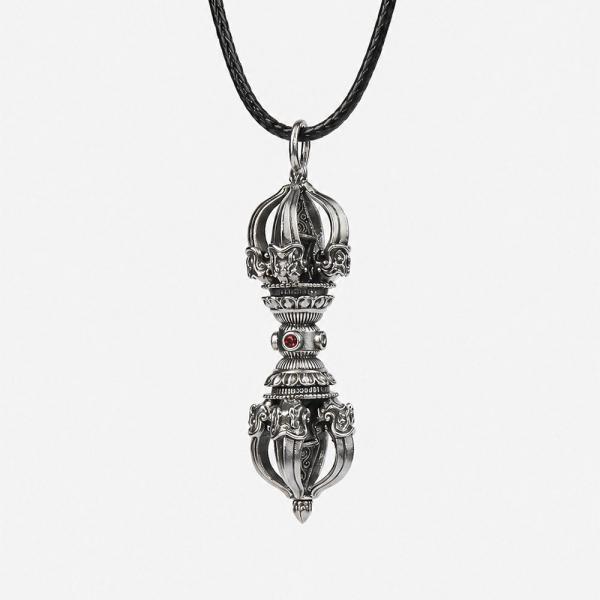
A single piece of southern red agate is set into the body of the vajra, the red landing in the cool tone of the copper, and it is the eye of the piece. Southern red is one variety of agate, running from persimmon to cherry, and this stone is small: set into the vajra to give it a focal point, it also pulls the form away from ritual implement and toward ornament. The red is on the dark side rather than bright, which holds its own against cool white copper. It goes faintly translucent only under light; without light it reads heavy.
Setting means cutting a channel in the copper, seating the stone, then pressing the copper edge over it. A little clearance is left between stone and channel so that expansion and contraction do not crack the stone. The pressure on the rim has to be even; heavier on one side and the stone sits off-centre, and off-centre means starting again. A small setting like this fears a fall: the stone chips first, a chip cannot be filled, and the stone has to be replaced. Channel depth has to match the stone, too deep and it sinks, too shallow and the girdle shows. The channel is cut with a small chisel, and one slip ruins the whole plaque.
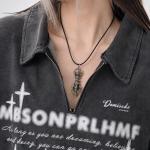
Two options, the pendant alone or with a sandalwood cord. The sandalwood cord is dark and holds the red down; against a silver-coloured chain the red jumps forward, which is a matter of taste. A cord sits against the chest while a chain slides, so the pendant rides at a different height. The sandalwood cord carries a faint wood smell that fades with wear, and the cord itself softens; it frays in time and is cheap to replace. Choose a thicker cord, because a thin one with a heavy pendant cuts into the neck.
In tantric Buddhism the vajra is an implement, meaning what is hard and sharp and cuts through affliction; southern red is a curio material in the Chinese heartland. The two were never a pair, and putting them together is an ornament's move. Setting stones into metal is not new, and old pieces commonly used turquoise and coral; turning to southern red today reflects how the market for materials has shifted. The prongs here are cut short, since long ones catch on clothing. Old turquoise often carries iron lines, while southern red is valued for even colour. The cool of the copper holds the red down, and the red lifts the copper.
White copper is unplated, and its own colour dulls with sweat, which in fact sets off the red. Southern red dislikes heat and strong alkalis, so take it off for showers and for washing up. Clean the copper with a dry cloth and do not let cleaning liquid soak as far as the stone, which loses lustre over time. It contains nickel, so sensitive skin should take note; worn against the body, the stone faces outward and sweat does not reach it. Southern red dislikes dryness, so bag it during long spells unworn and keep it away from radiators. The stone chips easily, so tuck the pendant inside your collar when you move furniture.