


Menu
By theme
By theme

{{ variable.name }} : {{ variable.values[selectedVariantsIndex[variable_index]].name }}
Quantity:
Black Tiger Xuantan means Zhao Gongming: Xuantan is the name of his altar, and the black tiger is his mount. Daoism calls him Zhengyi Xuantan Yuanshuai, folk custom calls him the wealth god, and in New Year prints he has a black face and a thick beard, an iron whip in one hand and a gold ingot in the other, a tiger crouched at his feet. Whip and ingot, one to each side, are fixed; swap the hands and it is wrong. The image settled later than the name, and in Daoist temples he is mostly placed in a side hall. Xuantan is a martial figure, not one dressed as a civil official.
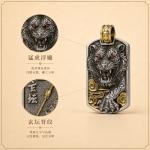
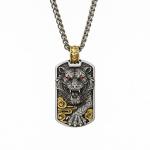
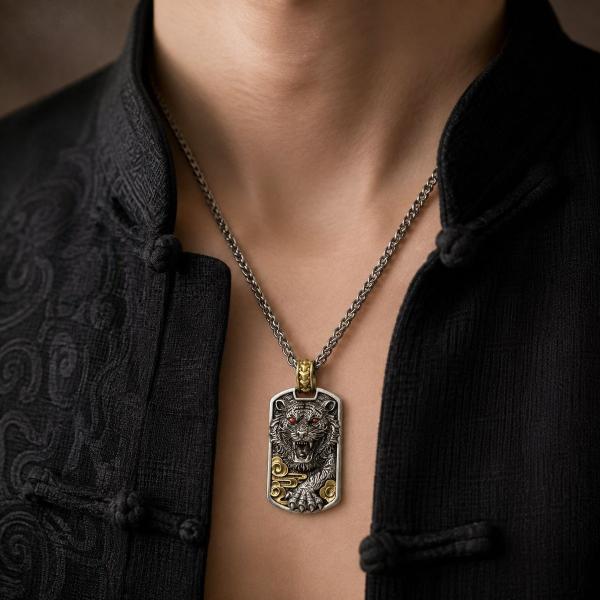
On the aged copper the tiger's stripes and the robe folds are pressed into hollows and go deep black. The figure dominates the face, while the tiger at the lower edge carries little weight, present to establish the mount. The stripes are pressed one by one without fine drawing, reading at a distance as a few dark lines. The face is small, so the proportion of man to tiger has to be right first. Look at the face, then the hands; identify what the hands hold and you have the figure. The aged tiger stripes sit in shadow and show only in light.
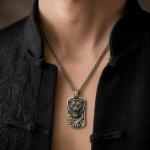
Two options, the plaque alone or with a Chopin chain. The Chopin chain is fine and soft, and against a thick plaque it does not look slight; the clasp is small, so hold both ends when putting it on. The plaque has thickness, and a layer of cloth underneath makes it more comfortable against the chest. Worn directly on skin, the back goes tacky with sweat and leaves a mark on the face by the end of the day. The hole is at the top, and the knot hides behind, so no thread shows at the front.
The name Xuantan comes from the altar ground in Daoist ritual. Zhao Gongming has an entry in the Ming compilation of the three teachings' gods, and only after the Ming did he settle into the look of a wealth god. That genealogy was layered on over time rather than painted in a day, and what different regions worship is not identical. In the ritual he was first a god who guarded the altar; managing wealth came later. Folk worship of a wealth god is mostly a print and a stick of incense.
White copper, and the aged layer fears wiping. Dust it with a dry cloth, use a soft brush in the hollows, and do not go over the whole face with polishing paste: one wipe and the black lifts and the outline of the figure goes with it. It contains nickel, so sensitive skin should wear it briefly. Take it off for showers, since soap left in the hollows turns them dull. An aged plaque brightens with wear, the raised parts first, and settles once it reaches a certain point. Wipe in one direction rather than scrubbing back and forth. Copper dislikes alkali, so keep soapy water off it.