


Menu
By theme
By theme

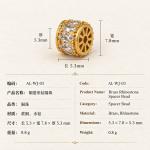
{{ variable.name }} : {{ variable.values[selectedVariantsIndex[variable_index]].name }}
Quantity:
Marquise is an old name in stone cutting: long, tapering to a point at each end, shaped like an open eye. It was fashionable in eighteenth-century Europe and was later applied to all sorts of materials, not only gemstones. As a spacer bead the shape has one clear advantage — from any angle there is a long, narrow band of reflection. The name comes from the cut, not from any place of origin, and today many materials are cut this way for the sake of that vertical line of light.
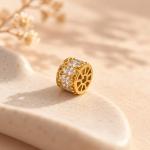
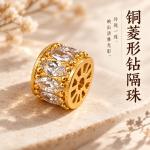
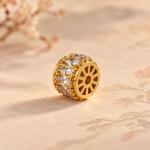
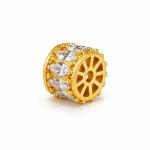
The bead itself is a rhombus with the four corners rounded and a hole drilled through the middle. On a strand it finds its own angle, turning as you walk so the light jumps with it. One is enough between plain beads; two turns the piece into a decorative chain, which is a different thing altogether. The chamfer at each end of the hole needs to be round, or hard wire will chip it — the first step to be skipped on small work. Spacer bores are usually smaller than the main beads, so test the fit before stringing, and if it jams do not force it round with pliers.
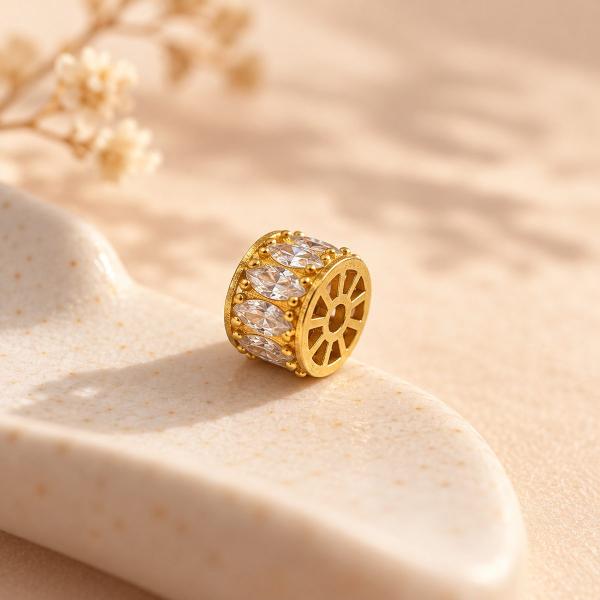
Copper base, gold plated, with the stone held in a closed bezel so no claws sit proud and there is less to catch on clothing. The gold is warm, and set against the cool white of the zircon the contrast is obvious; that warm-and-cool pairing is the most engaging thing about the piece. Warm gold tends to flatter sallow skin. The bezel has to be even in thickness, or the stone sits high on one side and looks crooked head-on.
The stone is zircon, with a high refractive index, more fire than ordinary glass and a clean colour. Its hardness is below that of diamond, so a knock on a hard surface will chip the edge, which is why the metal setting wraps all four corners — and why the rim of this spacer looks thicker than you might expect. Zircon holds its colour, unlike dyed stone which fades with wearing; when choosing, turn it in the light and see whether the fire spreads out from the centre.
Avoid knocks in daily wear, especially on the inner wrist, where desk edges and door handles are the usual culprits. Take it off to wash your hands; plating will not stand repeated soaking in soap. For fingerprints on the stone, use a lens cloth rather than a tissue, whose fibres leave fine scratches. Put a cloth down on the table when you are doing handwork — a piece this small drops more often than you would think, bounces once and is gone.